Monday, March 26, 2007

#11 Screwtape Letter: Humor

It turns out that the couple the patient befriended in letter #10 enjoys laughter and Wormwood is curious as to how to utilize this to ensnare the patient. Screwtape explains to Wormwood that there are different causes of human laughter, and only some of them are really beneficial to their cause.

‘I divide the causes into human laugher into Joy, Fun, the Joke Proper, and Flippancy. You will see the first among friends and lover reunited on the eve of a holiday. Among adults some pretext in the way of jokes is usually provided, but hr facility with which the smallest witticisms produce laughter at such a time shows that they are not the real cause…the phenomenon is of itself disgusting and a direct insult to the realism, dignity, and austerity of Hell.”

So Joy is of little use. Fun too is difficult to utilize other than as diversion from more important things, Screwtape tells Wormwood. The third and fourth however are more promising. The Joke Proper is defined by Screwtape as a joke “which turns on sudden perception of incongruity.” The main area that Screwtape goes for with this type of comedy is the bawdy joke. Lewis argues that only if the joke incites the listener to lust and not only to humor is the joke helpful to Screwtape. This is an area which I think Lewis is skating too fine a line if he’s not plain wrong. Sexuality is of a nature that is so sacred and so private that I think it’s very difficult to imagine a situation in which jesting about sex does not in some way diminish the importance of the act itself. This diminishing can hurt our ability to respect and utilize it for the ends that God intended it (namely an expression of love). So while I’ll agree with Lewis that a joke about sex is far more serious if it incites lust, all sexual jokes run the risk of doing damage regardless of the feelings they incur.

Before discussing Flippancy, Lewis chooses to digress to talk about a dangerous aspect of humor. That is, its ability to justify the unjustifiable. Screwtape explains:

“(Humor) is an invaluable as a means of destroying shame. If a man simply lets others pay for him, he is ‘mean’; if he boasts of it in a jocular manner and twits his fellows with having been scored off, he is no longer ‘mean’ but a comical fellow…Cruelty is shameful-unless the cruel man can represent it as a practical joke. A thousand bawdy, or even blasphemous, jokes do not help towards a man’s damnation so much as his discovery that almost anything he wants to do can be done, not only without the disapproval but with the admiration of his fellows, if only it can get itself treated as a joke.”


It is important for us to recognize that harm done in jest is still harm and as such should be avoided. This part however has the extra danger of convincing ourselves that we are in fact doing no wrong. Being sinful and being unaware of its consequences is a two-edged sword with which we ought not to play.

Finally, Screwtape discusses Flippancy. The danger in Flippancy is quite simply an inability to take seriously what we need to take seriously. Flippancy promotes an idea that there is nothing grave and this is problematic when trying to deal with weighty matters of the soul. In these cases we need to be serious and to accept the horrifyingly real consequences of the decisions we make. If everything is a joke, if the demons are funny little men with pitchforks and the angels little women with shiny circles floating above our head, then how are we supposed to quiet ourselves to listen to good and to make firm difficult decisions, particularly about sacrificing ourselves. As Screwtape says, “If prolonged, the habit of Flippancy builds up around a man the finest armour-plating against the Enemy that I know, and it is quite free from the dangers inherent in other sources of laughter.”

So laugh. Laughter is good. But be careful about what you’re laughing about so that when the time to laugh passes you can cease laughing and start listening.

Sunday, March 25, 2007

Screwtape #10: The Company We Keep

First of all, sorry for the delay between these. It’s been a busy few weeks, and even now I’m squeezing time to crank this one. Still, I hope to make these regular again.

Recall that Screwtape and Wormwood have the patient in a dry spell in his faith. In this letter, the two discuss a new set of friends that patient has made. This delights the devils, as the pair is

“just the sort of people we want him to know-rich, smart, superficially intellectual, and brightly skeptical about everything in the world. I gather they are even vaguely pacifist, not on moral grounds but from an ingrained habit of belittling anything that concerns the great mass of their fellow men and from a dash of purely fashionable and literary communism.”


This sound familiar? Is this not the type of people we are surrounded by at the university? Replace “communism” with “postmodernism” and it’s a nearly perfect fit for many we meet and interact it with. So as university students, if the people we associate most with make dangerous friends, we need to be on watch. But for what? Are we not supposed to engage these people in the New Evangelization? Yes, but we have to be very careful. In order to make friends we have to be “nice” and “nice” can mean sacrificing part of our responsibility as Catholics.

“He will be silent when he ought to speak and laugh when he ought to be silent. He will assume, at first only by his manner, but presently by his words, all sorts of cynical and skeptical attitudes which are not really his. But if you play him well, they may become his. All mortals tend to turn into the thing they are pretending to be.”


That is, if in engaging these people we do not hold a firm grasp on our Catholicism and are not careful for the slips through which the presumptions of the devil can sneak into, we can easily be swept away by the tide. We have to recognize that even though all new friends are pleasures, they can also be temptations.

In these type of friendships there is also a danger of pride arising. Lewis explains:

“He can be made to take a positive pleasure in the perception that the two sides of his life are inconsistent. This is done by exploiting his vanity. He can be taught to enjoy kneeling beside the grocer on Sunday just because he remembers that the grocer could not possibly understand the urbane and mocking world which he inhabited Saturday evening; and contrariwise, to enjoy the bawdy and blasphemy over coffee with these admirable friends all the more because he is aware of a ‘deeper,’ ‘spiritual’ world within him which they cannot understand.”

That is, in dealing with several different groups of people we are tempted to think that our associations with others make us better than everyone else. This can even be true within different Catholic groups; going to the orthodox church while the liturgical dance class could be an example. The important thing is trust first of all in Jesus for our faith and to watch as our beliefs shift with the tide to make sure they’re shifting closer to Christ. Second, it’s to remain humble despite the many people we have the privilege of knowing and becoming friends with. Then we’ll frustrate Screwtape.

Friday, March 23, 2007

LSU Politics and Religion Conference

The Political Science graduate students of LSU are hosting a conference tomorrow, March 24, on "Politics and Religion: Tolerance and Conflict in Society." It will be from 9:00 AM until 4:00 PM in the Vieux Carre Room of the Student Union. It would be great to have some Parousian support! Free lunch provided!!

Thursday, March 22, 2007

Wednesday, March 21, 2007

And in This Cornerrrrr, God's Rottweiler!

Don King Visits Vatican; Gives Gifts to Benedict XVI

I think if King wanted to sign B-16, it would make for an awesome fight. B-16 versus Richard Dawkins in the theological fight of the Ceeeeennnntuuurrry. Of course, B-16 would be advised to watch some Rocky before the fight, but I still think he could take on anybody.

Monday, March 19, 2007

A Reflection on St. Joseph Courtesy of Fulton Sheen

St. Joseph has become one of my favorite saints over the past year. I've spent a lot of time contemplating the decision he made to become the stepfather of Christ and the amount of faith and sacrifice in that decision. I probably wouldn't have started this if it was not for an entry about St. Joseph in Archbishop Fulton J. Sheen's The World's First Love:

But when one searches for the reasons why Christian art should have pictured Joseph as aged, we discover that it was in order to better safeguard the virginity of Mary. Somehow, the assumption had crept in that senility was a better protector of virginity than adolescence. Art thus unconcsciously made Joseph a spouse chaste and pure by age rather than virtue...To make Joseph appear pure only because his flesh had aged is like glorifying a mountain stream that has dried. The Church will not a ordain a man to the priesthood who has not his vital powers. She wants men who have something to tame, rather than those who are tame because they have no energy to be wild. It should be no different with God.

...Joseph was probably a young man, strong, virile, atheletic, handsome, chaste, and disciplined; the kind of man one sees sometimes shepherding sheep, or piloting a plane, or working at a carpenter's bench. Instead of being a man incapable of love, he must have been on fire with love....Instead, then, of being dried fruit to be served on the table of the king, he was rather a blossom filled with promise and power. He was not in the evening of life, but in its morning, bubbling over with energy, strength, and controlled passion.


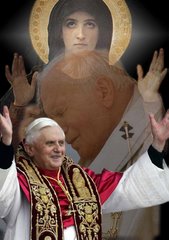
You know, while typing this and the part about Joseph being young and strong the image of JPII came to my mind. I think that image helps confirm Sheen's belief in the young Joseph as being more appropriate for our conception of St. Joseph.

Happy St. Joseph's Day!


I want to wish everyone, particularly the Italians, a happy feast of St. Joseph! Hope everyone doesn't go overboard with their altars!

Shameless Self-Promotion

For the Greater Glory

I've just launched a blog of my own! (groans from the audience). Some stuff on it is serious, most of it is just fun. Granted, my idea of fun is NASCAR, so you may need to be careful. I talk about everything, but politics has been a big focus of the blog so far as it hasn't been on my postings here. So look at it and tell me what you think (I know the color scheme is a little odd; I'm working on it).

Friday, March 16, 2007

Latest Word from the Vatican on the Eucharist

The Vatican just came out with a new document on the Eucharist, Sacramentum Caritatis. The statement came out after the Synod of Bishops on March 13. Looks wonderful!

Feast of Annuciation to be hijacked for the cause of ordaining women priests

14th Annual dissident fest

I really like the two suggested encyclicals at the end of this piece that the Curt Jester puts up.

Chilling Tale of Planned Parenthood

Why is You Crying? You Ain't Pregnant!

This from Dawn Eden's blog. Thanks to Curt Jester for the story.

Wednesday, March 14, 2007

Rebuttal to Emily Byers's Column on Why Women Can't Be President

In discussing the fallout from Emily’s column, one person told me that I didn’t fully understand the commotion because I was a man. Because I’m not a woman, I didn’t comprehend how personal the column was. However, I do have some claim to be personally touched and so I must continue, but I will explain this claim.

I grew up in a single-parent household. My mother raised me from when I was 4 and a half and my sister from when she was 1. My mother is a very strong woman. She managed to raise two incredibly young children by herself. If being suddenly widowed with two small children is not a crisis, then I don’t know what is.

So when Emily wrote in her column about how women couldn’t handle crises, the image of my mother came to my mind. Perhaps this isn’t as personal as an attack on one’s own sexuality, but the bond between mother and son is one of the strongest known to mankind. So in a sense, the column was personal to me too. I wasn’t very angry about it as I certainly don’t think that Emily meant to slight my mother. Also, I wasn’t too upset as I can see the value in much of Emily’s argument and I see much we agree upon. It is mainly in her conclusion stated in the headline that we disagree.

My position is that Emily in her column took the application too far. While men may naturally make better leaders than women, to say that it is impossible for a woman to lead is to take it too far.

I’m a big fan of the popular writers like Lewis and Sheen, so I’m going to make an analogy to try to demonstrate the principle I’m working off of. Let’s take the example of a single parent family. We would all agree (and I especially) that having a mother and a father is an optimal situation in which to raise children as it demonstrates both sexes so that the children learn justice tempered with mercy and learn how to properly relate to members of both sexes from a young age. However, if one of the parents died, the survivor faces a difficult situation. If God does not call them to remarry, then they have to raise their children in a less than optimal state.

Does this mean that a person cannot raise a child in a single parent family? Would the survivor be forced to marry again quickly? If the survivor doesn’t remarry, should the children be taken from the parent and moved into a family in which there are two spouses? While we agree that a mother and father are best, looking from those choices we would say that no, the parent is not obligated to remarry and can raise the children on his or her own.

This demonstrates that optimal situations are not necessary situations. While having two parents is best, it is not required (let me make sure I clarify here that single parenting is different from gay parenting, which skews the traits of the sexes in the children). In the same way, while men may make better leaders than women, it is not necessary that men always rule.

Why then does Emily believe that women are incapable of the presidency? The crux of her argument is that women would be less able to lead in a crisis because they are too emotional. She points to the example of Gov. Blanco. First, I think she makes an assumption here, namely that being logical and just in a crisis is always the best way to handle a crisis. While this might be true in most cases, it is not true in all. In Katrina for example both care and logic were required: Logic to restore the traditionally male notion of order to the city of New Orleans and care and compassion to deal with the evacuees. A logician dealing with evacuees might turn them away, rightfully arguing that the evacuees cause an inconvenience at best and severe problems at worst. Considering what’s happened in Houston since the storm, we really couldn’t blame them for keeping the gyms locked up. So we can see that a sense of compassion is necessary for leaders in some situations.

My second response to this is based off of a quote by Bishop Fulton J. Sheen in World’s First Love:

Which stands up better in a crisis: man or woman? One can discuss this in a series of historical crises, but without arriving at any decision. The best way to arrive at a conclusion is to go to the greatest crisis the world ever faced, namely, the Crucifixion of Our Divine Lord. When we come to this great drama of Calvary, there is one fact that stands out very clearly: men failed...In contrast, there is not a single instance of a woman's failing Jesus. At the trial, the only voice that is raised in His defense is the voice of a woman....This is the greatest crisis this earth ever staged, and women did not fail. May not this be the key to the crisis of our hour? Men have been ruling the world, and the world is lapsing.


While standing at the Cross might be a different thing from leading a country, I think at least we can see the point. If one believes Sheen’s argument, then women might actually be better than men in handling crises. Now, this argument can be critiqued on the basis of the actions of John the Beloved, but still the implication that more women succeeded than men in the crisis of Calvary is very significant to the discussion. So while Blanco might have failed, Mary did not. I would take Mary to be the more substantial indicator of the potential of femininity.

It also worth noting that Mary did not lose any of her feminine dignity in handling the crisis, which brings us to the next point of the article: that women, in order to be good leaders, would have to emasculate themselves. Emily is concerned that women would have to build up such emotional detachment, among other things, that they would cease to be a good example of a woman. In other words, Emily sees that a woman would have to sacrifice part of her emotional attachment and she doesn’t want to see this sacrifice happen. I agree with Emily that a tremendous amount of emotional detachment is inherent to the job but she fails to consider the opposite side. That is, is the amount of detachment good for men either? It would be less drastic for men than for women, for sure, but making the decision to either drop the atom bombs and destroy two cities of citizens or send about a million soldiers for whom you are responsible is hardly one in which any emotional attachment is called for. In either one of those choices enormous amounts of people die. You can say that “well, you did the right thing” all you want, but the emotional toll on anybody, man or woman, is incredible and probably unhealthy. This is why states are favored to be small, so that such enormous responsibility is not one head, but that’s besides the point. The point is while Emily says the detachment necessary is bad for women, it’s bad for men too. Anybody seeking the job is going to have to make that sacrifice. With that in mind, it seems odd to say that men can sacrifice it while women can’t.

Emily goes on to say that women shouldn’t feel like they have to be president. I agree. We shouldn’t be aiming at the best woman for the job, just as we shouldn’t be looking for the best Catholic, African-American, Hispanic, etc for the job. We should be looking for the best person for the job. This is why I think Emily’s position can be a bit dangerous. If we were presented with a choice between candidates in which the woman is the superior candidate, then we should choose the woman. If for instance, we had a pro-life woman running for president named, oh I don’t know, Emily Byers. Emily is running against a pro-choice man. Or maybe a utilitarian man, or a fascist man, whatever your scariest position is, this man has it and is running against Emily. I would argue in this case one not only is allowed to vote for the woman, but is in fact obligated to vote for the woman. Emily’s column seems to suggest otherwise in that the man is always going to be the best candidate in a matchup with a woman. I think even Emily would be in favor of voting for a pro-life woman over a pro-choice man, so I think her argument falls apart (I would especially hope that Emily would vote for herself).

The only argument I see working for Emily is one that she spends too little time on. That is, the argument of foreign standing. Emily is right in writing that many foreign countries look down on women and so it would be more difficult for a woman to be as accepted, if she ever could be, in dealing with those nations. As much of the United States’ diplomatic need is in countries in the Middle East, this would seem to be especially problematic. Condolezza Rice and St. Joan of Arc can be brought up as counter-examples to this argument, but even then they were both seen not as primary leaders but representatives of male leaders (Bush in Rice’s case and the King of France in Joan’s). However, note that this argument is very different from the one Emily makes in the rest of her column and in her thesis. Namely, Emily is trying to argue that women are inherently worse candidates. The argument of foreign standing does not make a judgment on the intrinsic capacity of women but rather the state of affairs in the world. The argument of foreign standing would be equally applicable in a world in which Planned Parenthood has taken over and now men (and babies) form the lower and disrespected group.

In summation, it might be optimal for men to be presidents. However, in a time of need women could certainly answer the call. So I’m afraid I must respectfully dissent from Emily’s column.

Tuesday, March 13, 2007

I Might Actually Watch TV If These Things Were On

List of Potential Shows for New Vatican TV-Courtesy of the Curt Jester

He Shall Not Go Quietly Into the Night

Cartoon of Fr. Euteneur

Fr. Euteneur was the priest that Sean Hannity blasted. What hasn't been posted on this blog yet is that a priest who worked for Fox News, a Fr. Johnathan Morris, replied calling Fr. Euteneur out of line. Fairly absurd if you've seen the video. Anyway, Fr. Euteneur did not hesitate to reply. I think this is a particularly intriguing discussion as it has implications on my post about proper dissension between Catholics. Fr. Euteneur's response can be found here: The letter to Fr. Morris It has trouble loading, so it give it some time. As for Fr. Morris's original letter, it can be seen here: Fr. Morris's Open Letter to Sean Hannity

In case you haven't seen the video, that can be seen here: Hannity bullies clergyman

P.S. Thanks to Catholic Cartoon Blog for the scoop!

LSU Welcomes Dr. Daniel J. Mahoney

LSU welcomes guest speaker Dr. Daniel J. Mahoney of Assumption College on this Thursday March 15. Dr. Mahoney will be lecturing in the Hill Memorial Library at 3:00 PM on "Politics and the Human Soul: The Continuing Relevance of Aleksandr Solzhenitsyn." Solzhenitsyn spent many years in the Russian Gulag and converted to Russian Orthodox Christianity as a result of his experience. The lecture will be very dynamic! I encourage and welcome all of you to come!

Monday, March 12, 2007

No laptop for you!

Via Paul Cat, everyone is to shut off his computer for 24 hours on March 24 in honor of my birthday and the martyrdom of Archbishop Oscar Romero.

Saturday, March 10, 2007

A Priest Stands Up to Sean Hannity

Page with a Link to Video of Sean Hannity vs. Priest

I used to like Sean Hannity during the 2004 election. But now he goes after a priest on the issue of birth control and the sex scandal? Look at the video which for the moment is up at the right hand side of the screen (I couldn't link at it directly). It's disturbing. Big props to the priest; I think I'm done watching Hannity. For everyone concerned about the priest, his website is: Human Life International. And this is an article that the priest, Father Thomas J. Euteneuer (what is it with awesome priests and "J" as their middle intial? ) wrote on the subject.

If you'd like to email Fr. Thomas Euteneuer, his email is lhunt@hli.org. If you'd like to email Sean Hannity, you might go to the website for his show, which is right here. That's enough links for now, lol. Enjoy.

UPDATE: This is a more permanent link to the video in question

Friday, March 09, 2007

Deep roots to a prime matter

From Notre Dame's campus paper, James Matthew Wilson addresses a crisis in today's Catholics. Have Catholics forgotten their identity and how to live the Catholic faith in the world? Or is it deeper? Is it that Catholics don't even know, or perhaps even care, about what the Church teaches and have in its stead taken up what the world teaches?

The Death of Catholic Culture

A Wiki Fraud

Guilty of using Wikipedia for a quick answer to your burning question about Catholicism?

You may regret that now.

Wikipedia's "Catholic Expert" exposed as a fake!

Pope Benedict XVI Talks about the Media

Courtesy of Drudge:
Pope Discusses Role of the Media

Pope Benedict Says Bob Dylan was a False Prophet

Ummm...maybe on second thought we should hold off on the Bob Dylan Videos lol

I've never listened to Dylan, so I can't say, but I would be interested to hear what some Dylan fans might have to say about this.

Thursday, March 08, 2007

Return of Emily Byers

Emily Byers comes back from hiatus with a strong column arguing that the difference in the sexes means that a woman should not be president.

Presidency is not a job for women

Woman Awakes from 6 Year Old Vegetative State

We're quickly approaching the anniversry of Terry Schiavo's murder. As we've done so much for the pro-life cause on the issue of abortion, it's important to note that the culture of death is busy seeping into other legal avenues as life continues to be degraded. This is a good story as it serves as a powerful testimonial that these people still are in fact alive and deserved to be respected as human beings, not human burdens.

The Story

Wednesday, March 07, 2007

They Don't Believe Us

When Catholics apply the slippery slope argument to things like contraception and homosexual marriages, we're often told that we're being extreme and trying to incite unreasonable fear. That loosening the sexual code does not lead to a complete neutrality on issues of sexuality.Unfortunately for them, we were right.

Tuesday, March 06, 2007

#9 Screwtape Letter: Pleasure and Dealing with the Law of Undulation

Screwtape continues advising Wormwood of how to deal with the patient in this rough period. He recommends that Wormwood look first to pleasures of the flesh, particularly sexual ones. He tells Wormwood:

The attack has a much better chance of success when the man’s whole inner world is drab and cold and empty. And it is also to be noted that the trough sexuality is…much more easily drawn into perversions, much less contained by those generous and imaginative and even spiritual concomitants which often render human sexuality so disappointing…You are much more likely to make your man a sound drunkard by pressing drink on him as an anodyne when he is dull and weary than by encouraging him to use it as a means of merriment.


What Screwtape is getting at here is that when we are happy, truly happy, that is because in some way we have experienced God so that when it’s accompanied with pleasures of the flesh like drink it’s simply a complement, not the focus. Screwtape wants it to be the focus and that’s more easily done when we’re unhappy. Using the example of pornography, Screwtape sees showing it to a happily married couple as far less fruitful than to showing it to the lonely man who just broke up with his sweetheart. In times of drought, it is God we are to turn to. If Screwtape can replace that with food, sex, or anything material that is not Christ, then Screwtape’s won the battle because any time we suffer we don’t get the redemption of God. Besides, many say that we are most truly who we are when we are down and out. Screwtape, accompanied with an idea that a world without joy is most real, wants us to think that what is most real is the material object with which we have replaced God instead of God himself.

Screwtape recommends caution however in playing with the pleasures:

Never forget that when we are dealing with any pleasure in its healthy and normal and satisfying form, we are, in a sense, on the Enemy’s ground. I know we have won many a soul with pleasure. All the same, it is His invention, not ours. He made all the pleasures: all our research so far has not enabled us to produce one. All we can do is to encourage the pleasures which our Enemy has produced, at times, or in ways, or in degrees, which He has forbidden. Hence we always try to work away from the natural condition of any pleasure to that in which it is least natural.


I’m sure you’ve heard it before, but pleasure in moderation (to put it in Aristotelian terms) is good: food, drink, sex, etc. It’s all designed by God. I believe somewhere in Mere Christianity Lewis talks about how God likes pleasures because He created them. It’s important, especially with sex, to keep in mind that pleasures properly understood can in fact enhance our ability to enjoy life and come closer to God. A drink and a fine meal can encourage fellowship which strengthens our community for instance.

After the pleasures, Screwtape advises Wormwood to start messing with the patient’s mind:

Do not let him suspect the law of undulation. Let him assume that the first ardours of his conversion might have been expected to last, and ought to have lasted, forever, and that his present dryness is an equally permanent condition.


I spoke a little about this last time. Understanding that we are naturally going to rise and fall helps us during the fall to not lose hope and during the rise to be more on guard. The battle is never fully won or fully lost; if we think either one, then the battle’s over and more likely we’re on the wrong side. Unlike many “once-saved” Christians, we believe that conversion is a continual process throughout our lives, and we always need to stay on top of it and be aware of the problems we may face. This however, does not mean that we don’t do anything about the troughs. Screwtape would like us to do either that or too much:

…then set him to work on the desperate design of recovering his old feelings by sheer willpower, and the game is ours. If he is of the more hopeful type your job is to make him acquiesce in the present low temperature of his spirit and gradually become content with it, persuading himself that it is not so low after all. In a week or two you will be making him doubt whether the first days of his Christianity were not, perhaps, a little excessive. Talk to him about ‘moderation in all things'…A moderated religion is as good for us as is no religion at all-and more amusing.


So don’t try to force getting better nor should we accept the trough as the way it ought to be. God wants us to live in joy and that is what we should seek. But we cannot do it by our own will not only because that will ultimately fail, but because that effort puts the focus back on ourselves when to be in joy the focus needs to be on the divine. We have to come to God humbly and ask for His help. We have to turn towards the sacraments for the grace to lift us up. If we persist, the door will be opened, and we will rise out of the trough.

Next letter: Associating with Non-Christians.

Monday, March 05, 2007

Speaking of NFP...

Tonight's LSU Parousian meeting was about abstinence education. One of the things we discussed as critical to a sexual education was educating kids about the problems and success rates associated with contraception as well as educating kids about how NFP works. I think this study would be tremendous in pushing to kids the unneccessary nature of artificial contraception. I saw this on a facebook note first from Andrew Kleiner from Conception College in Missouri so thanks to Andrew for the great info!

Study Shows that NFP is slightly MORE effective than artificial contraception.

Sunday, March 04, 2007

Godspy Reviews "The Departed"

Discussion about the Departed and Fatherhood.

Prefect for the Congregation for Doctrine of the Faith Speaks Out

Courtesy of "Whispers in the Loggia," Levada Gives an Interview.

#8 Screwtape Letter: The Law of Undulation

The eighth letter begins a few letters in which the patient starts to slip away from God’s fingers and closer to Wormwood. Wormwood is overjoyed by this prospect but Screwtape tells him to get his head on straight and not celebrate too much (apparently the devils have learned moderation?). This falling away, Screwtape tells Wormwood, might not be indicative of the patient’s falling away but instead be a natural part of the life of faith. Screwtape writes,

Humans are amphibians-half spirit and half animal (The Enemy’s determination to produce such a revolting hybrid was one of the things that determined Our Father to withdraw his support from Him.)…This means that while their spirit can be directed to an eternal object, their bodies, passions, and imaginations are in continual change, for to be in time means to change. Their nearest approach to constancy, therefore, is undulation-the repeated return to a level from which they repeatedly fall back, a series of troughs and peaks.

I think it’s fascinating that Lewis maintains that the very concept of humans played a role in Satan’s fall. I think a contrast exists between that and Jesus’s willingness to become not only a human but also to associate with sinners. Satan is one of the biggest purists, Lewis is saying, not with respect to orthodoxy but with respect to bringing the sacred to the profane as God brought the spiritual to the material. The desire to withdraw from instead of engaging the fallen culture in a sense is similar to the desire that Satan had. As Parousians, I’m probably preaching to the choir as we’re committed to a sense of faith and culture and engaging in culture in ways that we’ve done the past week (see my post: LSU Parousians Engage the Consuming Fire Fellowship and Planned Parenthood).

The other important thing is, of course, the law of undulation. Lewis is telling us that it is natural for humans to go through ups and downs. In fact, Lewis suggests that it’s necessary for us to approach the constancy which we will fully participate in when we’re outside of time. Understanding the law of undulation is a tremendous advantage for us. Every rise in joy does not mean we’ve finally triumphed nor does every fall mean we’re in a crisis of faith that requires a re-evaluation of everything. Stress and doubt are powerful tools Screwtape can use to discourage us. Screwtape goes more into how the devil can use the law of undulation for his purposes in the next letter, (#9) but he does tell us in this letter how God plans to use the troughs.

Now it may surprise you to learn that in His efforts to get permanent possession of a soul, He relies on the trough even more than on the peaks; some of His special favourites have gone through longer and deeper troughs than anyone else…It is during such trough periods, much more than during the peak periods, that it is growing into the sort of creature He wants it to be. Hence the prayer offered in the state of dryness are those which please Him best…Our cause is never more in danger than when a human, no longer desiring, but still intending, to do our Enemy’s will, looks round on a universe from which every trace of Him has vanished, and asks why he has been forsaken, and still obeys.

Is that something we can do? To have little hope of joy on this planet, to see everything good stripped from us and life and see only darkness in the future and to not want to walk on and yet still plunge headlong into the darkness because we believe with no reason that there is a God whose beauty and goodness will eventually shine through? That’s a lot to ask of us, yet it is that which precisely the definition of true faith is. Truth, Beauty, and Goodness may do well to show people that there’s a God, but when we can’t see those things it is then that we’re really called to be a people of faith. It is that moment on which salvation rests.

Why should it though? Why does God look for such things? Screwtape tells us it is this desire for us to choose in the troughs which divides heaven from hell and the demons from the angels.

One must face the fact that all the talk about His love for men, and His service being perfect freedom, is not (as one would gladly believe mere propaganda, but an appalling truth. He really does want to fill the universe with a lot of loathsome little replicas of Himself-creatures whose life, on its own miniature scale, will be qualitatively like His own, not because He has absorbed them but because their wills conform freely to His…Merely to override a human will (as His felt presence in any but the faintest and most mitigated degree would certainly do) would be for Him useless. He cannot ravish. He can only woo. For His ignoble idea is to eat the cake and have it; the creatures are to be one with Him, but yet themselves; merely to cancel them, or assimilate them, will not serve.

So while the devil wants to subvert and eliminate our will, God wants to actualize it fully so that we can be fully with him. The greatest way of actualizing this is by choosing God just for God. When we’re in the trough periods, there’s nothing else. Our love for God seems to have no benefits and only pains. An unrequited love is quite painful, yet to continue in it demands great nobility on our part and even greater love for the beloved in order to persist. It is that love of God only for Him that most pleases God, and the choice by us to love God in that way is what will set us free.

Friday, March 02, 2007

Exciting New Discovery!

Courtesy of Mark Shea's blog, this is a pretty funny piece to start off your weekend.


Exciting New Tomb Discovery In Mississippi.

LSU Parousians Engage the Consuming Fire Fellowship and Planned Parenthood

"So much death. What can men do against such reckless hate?"
"Ride out with me. Ride out and meet them."-Theoden and Aragorn, Lord of the Rings: The Two Towers

This week was about taking the faith that has been enriched and strengthened by that peculiar bond of fellowship we call the Parousians into the campus. Specifically, into places we knew would be hostile to that faith, places in which we would certainly be challenged. However in both instances I can say that the Parousians came out with a stronger faith and the belief that we made things better by being there and representing the truth.

The first instance came on Tuesday. Every two weeks on Tuesday a group from the Consuming Fire Fellowship comes into LSU’s “Free Speech Alley” and preaches their beliefs. Most of their discussions are about sexuality and sin and salvation (and generally how we have too much of the first two and none of the last). This of course perturbs a great number of the student body who are atheists and what have you. So generally when the Consuming Fire Fellowship comes to campus, we can expect a lot of yelling back and forth and probably a lot of hate as well. Perhaps this would be fine and irrelevant to the Parousians, except that one of the signs they wear has a list of the people going to hell. Next to abortionists, Jehovah Witnesses, and sodomites are, you guessed it, Catholics. I thought that this would be the perfect place to put the love and mercy of the Blessed Mother, so I invited people to come pray the rosary in “Free Speech Alley.” Because it’s the beginning of LSU midterms and during class time, we could only get one other person besides me to go to the rosary, Parousian and Guard member Liz Johnson. That’s alright; I announced it kinda late, and I’m positive it will build. Since we had small numbers, we decided to pray the rosary off to the side.

So we began the rosary. At first the only attention we got from the preachers was from their children. Every time I looked up I could see two little girls casting glances at us. According to Scott Hahn’s wife, Kimberly, the Virgin Mary is almost despised in Protestant circles and I imagine a similar situation if not worse occurs in the households of these young girls. Perhaps I am being fanciful when I say that I think something about the rosary clicked with them. Fulton Sheen argues that Mary is the woman that all girls want to be like, and I think that for those girls that flash of the perfect femininity was attractive or at least interesting and compelling.

It seemed that that would be all the response we would get going into the fifth decade. About halfway through the fifth, the guy with the sign saying that Catholics are going to hell came over and stood next to us. This is probably a child too but not too much younger than I am so that 16 or 17 would be about his age. And he began to tell us, “You know that’s not doing any good. She can’t hear you.” We prayed on. We said the St. Michael’s prayer as he was telling us, very respectfully I should note, that it was a waste of time. So we finished the rosary and immediately began to discuss with him the faith. Liz and I were later joined by another Parousian, Nicole Augustin. And we talked to him about our beliefs, particularly in regard to Mary, purgatory, and the Eucharist, each of us backing the other up when we needed it (Each of the girls did a fantastic job, by the way, which is required when paired with my attempts at apologetics). And he didn’t really know what to say. It was obvious that what we were saying, Michael (that was the young man’s name) had never heard. It clicked with him, and he didn’t know how to handle it. Eventually he got another preacher over and we debated with him awhile until the main preacher Britt Williams, who was also the young man’s father, arrived. Liz and Nicole had to leave for class, leaving me with Rev. Williams and what turned out to be a sort of circle of other people from the Consuming Fire Fellowship. They would come in and out and listen and then walk off, obviously interested in the debate. We talked about requirements for salvation and Church history and abuses. At the end he wasn’t convinced and I had to leave, though I intend to return in two weeks.

The second instance came tonight. A group calling itself “Spiritual Youth for Reproductive Freedom,” with the help of the LSU Women’s Center and a group called Vox: Voices for Planned Parenthood (I’m not quite sure why they use the singular “vox” for the plural “voices,” but that’s another issue) put on a series called “Spirituality and Choice.” This has been a three part series with a session on stem cells, one on sexual education, and the grand finale tonight on Abortion titled, "Can You Choose Choice? Religion and the Pro-Choice Movement". I missed the first one but attended the second one and knew that this was important. The perverse union between spirituality and their ideology is a dangerous one, one that can hurt many young people, especially women. So I wanted a big turnout at their event in order to challenge them. I set up a facebook event, told people about it for a week (and other people talked about it too; lemme be quite clear that any success is not solely my success). Being exam week and being a Planned Parenthood event, I was hoping we could get a few people to give a different perspective.

This was my mindset when I entered the room tonight a little early. I watched as people began to stream in and kept a tally of which ones I knew and which ones I didn’t (we had decided ahead of time to sit separately, so I didn’t have anyone to talk to). The count was a total of 40 people. 13 of them were Parousians. From the question session after that, I think there 5 more pro-lifers in the crowd at least, so that the pro-life group represented a little less than half the crowd. That is incredible. I was so glad to see that people could make it. This happened despite it being a hectic week, despite many people leaving to set up the Veritas retreat this weekend, and despite people’s natural hesitation to go to an event hosted by a pro-choice crowd. I feel we were very blessed.

The Planned Parenthood people probably didn’t feel the same way. They made sure the question and answer session was very short but starting late and letting the presenters read on and on from little stat sheets which were not even really abortion as much as they were about poverty. Yet when the question and answer session came, they were stumped. They couldn’t answer the very basic question a girl we didn’t know asked: when does the fetus become a human? The basic tenet of the pro-life movement and they couldn’t respond. Questions about whether or not a bad abortion was possible and whether or not abortion was simply sweeping under the rug the social issues they had so exhaustively discussed were similarly baffling to them. While no one agreed with us at the end, I think that we show at the very least that the pro-life position is one to be reckoned with and an idea that has significant intellectual merit, which was precisely the opposite goal of their forum.

However, the question can come up: what good did it do? On the surface, we had no conversions. No new Catholics, no new pro-lifers. Perhaps we touched some of them but how much will that matter when they go back to church on Sunday or go back to the Women’s Center and talk about the conference? Did we do any good or did we simply stroke our own egos by trying to beat our opponents in face to face debate? I have to admit, it’s possible that the seeds we tried to sow fell on bad soil. Even if they did however, we did something. I would say that at least for me I came away stronger in my faith, having seen it come up against its enemies and come out intact. But even more than that, I think that the seeds we planted will have an effect. God only needs a crack to flow completely through, and I think we showed these people the cracks in their armor. We made these people think twice about their positions. That’s allowing for God and the Holy Spirit to work. We’ll never know how much of a difference we made this week, but we made a difference.

I want to end this with a quote from the movie Mr. Smith Goes to Washington. In the movie, Senator Smith is forced to defend himself in the Senate and every other senator thinks him a fraud and a troublemaker and wants to expel him from the Senate, so in one of the great scenes of cinematic history Senator Smith filibusters. This is the conclusion to that filibuster (but not the movie, so don’t worry, I didn’t spoil anything for you).

“I guess this is just a lost cause, Mr. Paine. You people don't know about lost causes; Mr. Paine does...You know that you fight for the lost causes harder than for any others. Yes, you even die for them…I'm going to stay right here and fight for this lost cause even if this room gets filled with lies like these until the Taylors and all their armies come marching into this place. Somebody'll listen to me.”

It’s that last sentence which embodies all our hope. Somebody will listen to us if we only keep speaking in witness to Christ.

Wednesday, February 28, 2007

Tridentine Mass


I've attended a few Tridentine Masses and each time I've come away disappointed. Part of the reason for this could be that the masses I attended were in South Florida, where most of the Latin Mass church-goers look and act like Uncle Lewis and Aunt Bethany from National Lampoon's Christmas Vacation. But the bigger problem is that I came away each time feeling as though I hadn't been to mass at all. Perhaps I expected too much, but instead of experiencing awe and reverence I just felt frustration and disillusionment. I kind of assumed that it was a personal defect, perhaps the consequence of not having adequately prepared myself. So I was heartened to read this post by Dan at Holy Whapping, which perfectly captures the uneasiness I've experienced before in the Tridentine Mass:
when you show up at the local indult parish, you discover something very different from what you expected.
- Participation is discouraged, except perhaps on a few chants
- It is very hard to keep track of anything for those who haven't already gotten it down
- The whole experience has a vaguely dusty feel
- Many pamphlets and literature around the Church, with the exception of maybe some natural family planning materials, feel frozen in time somewhere around the 1920's.

What I am arguing, then, is that the Tridentine Mass, as currently celebrated in indult parishes, at least those I have seen, is celebrated in such a way as to necessarily become an "acquired taste." Furthermore, an approach is often taken to make it seem as if the indult is carte blanche to act as if nothing in the Church has changed since the early 1940's, and to make such completely orthodox movements as the nouvelle theologie or even Vatican II itself as a council, seem suspect. This is not a good approach, and it works very much against integrating traditional liturgy into the present day life of the Church. This approach is not one that, in my experience, easily appeals to young people looking for beauty and transcendence, unless they're already convinced to keep coming for other reasons, or have someone to explain everything to them in detail and keep them coming back.
...
In other words, why can't we have "tradition" without "ism" in these quarters, and be willing to have the Tridentine Mass and Vatican II and new developments in theology?
There's an extended discussion in the comboxes at Holy Whapping.

Tuesday, February 27, 2007

You Probably Knew This Already, But Just In Case You Didn't...

College Students More Narcissistic Than Before.

Maybe the Parousians Can Go Home Now

A new documentary claims that the remains of Jesus, his wife Mary Magdalene, and their son have been found. Titanic director James Cameron is the executive producer. I still haven't seen that one either.

I watched a little bit of CNN's coverage of this last night. It seems that the mainstream media is finding little credibility in the story, but will the consumer culture reject it?

But now, since we have the DNA samples, perhaps we can finally clone Jesus.

Monday, February 26, 2007

Happy Birthday

This is courtesy of Paul Cat. I think this video addresses something not talked about too often and that is the father's feelings following an abortion. The idea of reflecting on what the child would be has been brought up in connection with the mother but we often forget that the father will have the same naggings of conscience.

Happy Birthday, I Love You Whoever You Would Have Been.

Sunday, February 25, 2007

New Hope for Catholic Literature

The article Pop Excess cites Catholic Writers Groups Foster Literary Revival (both from the National Catholic Register) as part of a hopeful change in pop culture beginning with literature, "There’s another reason the arts have become a cesspool: Call it a sin of omission by Catholics.

For decades, the Church in America has been marked by dissent. Catholic filmmakers, novelists and artists have been here all along — but their products have become morally indistinguishable from the culture’s.

But that’s starting to change. There are two examples in this issue: Tim Drake’s story about the new literary revival (page 2) and our profile of Jordan Allott on our Arts & Entertainment page (B3)."

Tim Drake's article notes one group in particular, "The Minnklings," who are "a Minnesotan take-off on C.S. Lewis’ and J.R.R. Tolkien’s writer’s group The Inklings. Among others, it includes a newspaper publisher, an academic journal editor, published fiction writers and journalists. They gather to critique one another’s work and share stories about getting published. The group is one of several literary efforts underway aimed at supporting existing Catholic writers and fostering new ones."

Some very exciting stuff going on here.

Freedom of...Prejudice?

A quote by Greg Kandra from the National Catholic Register's article, The Bias Against Belief, “The episode has drawn attention to an issue that strikes close to my own life,” wrote Kandra. “It involves a particularly insidious form of bigotry, and the nagging suspicion that there is one remaining permissible prejudice in America. It is anti-Catholicism.”

Praying for Atheists

Mark Shea offers us insight into opening our hearts towards atheists in this article appearing in the National Catholic Register, Praying for Atheists.

Mark Shea writes in reference to atheism and atheists, "The truth, of course, is that there is always a difference between an idea and the person who holds it." This is perhaps something we should all keep in mind especially when working with our brothers and sisters who will not intellectually recognize God, but who so often recognize Him through their loving actions helping those less-fortunate than themselves.

#7 Screwtape Letter: Existence of Demons and Factionalism

This letter, more than any we’ve seen so far, really breaks itself down into two separate letters. The first half is devoted to the question of whether or not Wormwood should put special effort into keeping the patient ignorant of his existence. Screwtape answers that the question has been answered by the High Command to keep ignorant but he explains that both ignorance and belief have their drawbacks:

“When the humans disbelieve in our existence we lose all the pleasing results of direct terrorism and we make no magicians. On the other hand, when they believe in us, we cannot make them materialists and skeptics.”

That is, the existence of demons and Satan points us to a spiritual world in which materialism does not make sense. Without belief in this existence, it is easier for Wormwood to direct the patient towards world in which there is only matter, a world in which things like Truth and Morality start to lose meaning. On the other hand, belief in spiritual world is not enough for conversion but only heightens the stakes. Sure, belief in God can come but it can also be used for a more potent evil. Think of Star Wars for a minute (hey, you didn’t honestly think I was going to write about 31 letters and not refer to Star Wars once, did you?). Darth Vader and Emperor Palpatine both believed in the Force very strongly, but that belief did not translate into goodness. Instead, they manipulated this secret force for their own ends and became much more powerful than a legion of storm troopers. A similar thing can happen for those who see spirituality but misinterpret it or pervert it. Planned Parenthood is doing this right now at LSU with their Spirituality and Sexuality Series in which they claim that it is acceptable and perhaps even mandatory to be both spiritual and pro-abortion, pro-contraception, and pro-sexual liberation. So while we have to recognize that getting people to recognize the spiritual world is a crucial step towards lifting people out of the indifferent and hollow world of the materialists, it’s not the end of the journey. (Speaking of those Planned Parenthood people, 7:00 PM in the Atchafalaya Room in the Union on Thursday is the finale of their series. Please attend if you can. Now back to our regularly scheduled programming)

Screwtape mentions one more thing that is helpful for us to recognize. He tells Wormwood:

“The fact that ‘devils’ are predominantly comic figures in the modern imagination will help you. If any faint suspicion of your existence beings to arise in his mind, suggest to him a picture of something in red tights, and persuade him that since he cannot believe in that…he therefore cannot believe in you.”

We need to be careful in how we describe the forces of evil both to others and to ourselves, lest we make them too anthropomorphic as to be ridiculous. Satan and his servants existence, but images of pitchforks and horns help Screwtape more than they help us.

Now we get to the second half of the letter in which Screwtape address the issue of whether or not Wormwood should try to make his patient an extreme patriot or extreme pacifist. Surprisingly to us who live in a world in which support or dissent of the Iraq War seems to be the prime litmus test, Screwtape says it doesn’t really matter. As he says,

“All extremes, except extreme devotion to the Enemy, are to be encouraged…Some ages are lukewarm and complacent, and then it is our business to soothe them yet faster asleep. Other ages, of which the present is one, are unbalanced and prone to faction, and it is our business to inflame them. Any small coterie…tends to develop inside itself a hothouse mutual admiration, and towards the outer world, a great deal of pride and hatred which is entertained without shame because the ‘Cause’ is its sponsor and it is thought to be impersonal. Even when the little group exists originally for the Enemy’s own purposes, this remains true. We want the Church to be small not only that fewer men may know the Enemy but also that those who do may acquire the uneasy intensity and defensive self-righteous of a secret society of a clique”


That’s a pretty long quote so there’s a lot to unpack from it. The first is an obvious preference for moderation in beliefs. Note however that this does not mean indifference or a rejection of both patriotism and pacifism. Instead, it’s recognition that extreme beliefs can become consuming and as such take us away from Christ. Second, it shows a danger to anger that we as Catholics in the university and more importantly as Catholics in the world face. We are a small group and therefore have a real disposition to the “us/them” mentality. This is particularly challenging for us as Parousians and as the laity under the New Evangelization of John Paul II. We are called to engage a university which is hostile to us and we probably will need to rely strongly on others and on our Catholic community as well as Christ’s grace to make it through it, yet we cannot become so entrenched in our community as to become disdainful of anything outside of it. This primarily means loving those who would appear to be our enemies, including those at Planned Parenthood (and I’m writing this as much to me as I am to you. Told you Lewis had a knack to skewer everybody, even bloggers). Third, we have to watch out for factionalism in our communities. “Divide and conquer” is the old saying and it can wreak havoc. Not even the Church is immune; see those who hold hands at the Our Father and those who don’t as a good indicator that our Church is not as united as it should be. When we disagree then, one of our goals in disagreeing should be a greater unity then before instead of simply another faction.

You may have wondered how what seemed to be a discussion on war and pacifism versus patriotism turned into a discussion of factions. Lewis generally isn’t concerned with the correct stance on war as he is about our attitudes to it and how war as an especially trying emotional and spiritual experience can lead us closer to either Hell or Heaven. He is especially concerned with concern about the war becoming the central point of our existence and especially of our faith. Screwtape writes,

“Let him begin by treating the Patriotism or the Pacifism as part of his religion. Then let him, under the influence of partisan spirit, come to regard it as the most important part. Then quietly and gradually nurse him on to the stage at which the religion becomes merely part of the ‘cause,’ in which Christianity is valued chiefly because of the excellent arguments in can produce in favour of the British war-effort or of Pacifism…Once you have made the World an end, and faith a means, you have almost won your man, and it makes very little difference what kind of worldly end he is pursuing. Provided that meetings, pamphlets, policies, movements, causes, and crusades matter more to him than prayers and sacraments and charity-he is ours.”

That’s fairly harsh, and as a group devoted to many causes we need to pay close attention to what Lewis is trying to tell us here. He’s not telling us to back away from causes,-he wouldn’t have been so involved in popular apologetics if he didn’t think that the world needed to be told to wake itself up-he’s telling us that that shouldn’t be the focus. Instead, religion should be the focus and the causes derived from it. We seek pro-life changes because God has told us that we should respect the dignity of human life; we should not seek God b/c we’ve decided to be pro-life and need back-up. The same applies to all issues, not just issues of war. We follow causes because in them we follow God; we shouldn’t follow God because He takes us farther in our quest for the cause.

I want to close with a quote from Richard Nixon. Odd source for inspirtational quotes, I know, and I’m not a big fan of the man myself. However, this quote was a favorite of my father’s and so I’ve come to like it too.

“Always remember others may hate you but those who hate you don't win unless you hate them. And then you destroy yourself.”

N.B. I realized about mid-way through this that there are some who might not like the dichotomy between Patriotism and Pacifism, as many today are easily angered by the association of opposition to the war with being unpatriotic. First, those are Lewis’s word’s, not mine. Second, I don’t think Lewis was trying to imply that; he’s certainly not one to join in the chorus of those today who claim opposition to the war in Iraq is necessarily unpatriotic. Remember, Lewis was friends with J.R.R. Tolkien, who was a pacifist in some respects (though he saw the war with Germany as a necessary evil as he wrote to his son, who fought in the war). Both Tolkien and Lewis served in WWI and had problems resulting from it so I highly doubt that Lewis demands support for war in order to be patriotic. It should also be noted that the patient never fights in the war and Lewis does not argue that it is a victory of Screwtape that he stayed home.

Saturday, February 24, 2007

Prenatal genetic screenings

Unfit to live? Children with Down's syndrome in Canadian crosshairs

A Canadian medical group is advocating prenatal genetic screening for all pregnant women. Specifically, Down's syndrome testing seems to be the main focus. What does this mean for a woman pregnant with a child who has Down's syndrome? Will the testing make her better prepared to take care of this child? Or will the test give her a reason to abort her child? Is this a step towards better care of Down's syndrome children or just towards eugenics and the death of these children? Who gets to decide?

This is Getting Really Scary...

De Jesus's followers tattoo themselves with 666.

#6 Screwtape Letter: Preoccupation with the Future and Man as a Series of Circles

Now that the patient has begun to pray, Screwtape instructs Wormwood on more techniques to help misdirect his prayers and thoughts. The first method is looking to the future at the expense of the present. Screwtape writes:

It is your business to see that the patient never thinks of the present fear as his appointed cross, but only of the things he is afraid of. Let him regard them as his crosses: let him forget that, since they are incompatible, they cannot all happen to him, and let him try to practice fortitude and patience to them all in advance. For real resignation, at the same moment, to a dozen different and hypothetical fates, is almost impossible.

I think this approach is especially beneficial to Screwtape for a few reasons. The first is, as Screwtape saws, true resignation to a dozen fates is impossible. This means that by attempting to resign ourselves to everything, we actually prevent the resignation and full trust in God that we are seeking. Again, we shoot too high and miss. The second is that by concentrating on the future too much we forget to seek comfort on the present crosses that God is fully prepared to help us deal with. The Eucharist is our daily bread and as such the grace is best when applied to the daily i.e. present problems. Finally, I think that dealing too much with potential crosses likely inflates our ego. If we think that we’re dealing with twenty crosses when we likely only have two, we probably think that God is dealing us a harder card then we have. This can lead to an inflates sense of what God “owes” us as well as tendency to “holier than thou” as we believe that we alone are dealing with so much and persevering whereas others have much less to deal with.

The next paragraph deals with more of Screwtape’s directions on how to distract the patient from the real issue. You’ll have noticed by now that a major theme of the Screwtape Letters is distracting the patient from the truth of things into an imaginary comfort zone in which it is harder for God to work.

One can then formulate the general rule; in all activities of mind which favour our cause, encourage the patient to be unself-conscious and to concentrate on the object, but in all activities favourable to the Enemy bend his mind back on itself.

What this means is this: when we deal in sin, we need to look at ourselves. Give ourselves the hard look or the examination of conscience and see what we’ve done wrong so that we can ask for the grace to change it. On the other hand, when we are presented with good or do good or focus should be on God. When we view the sunset as the sun slowly sinks into the mountains bathing the area in an orange glow or when we see pictures of Mother Teresa, our focus should not be on how that makes us feel but on the cause of these scenes which is God. To take an argument from Aristotle, if the highest thing is contemplate the divine than we should be careful not to substitute that for contemplating us thinking about the divine. The difference might seem small but it opens a large hole for the Screwtapes.

The last thing to draw from this letter is the idea of man as concentric circles. I found this particularly interesting as I had read something similar in a book called Lift Up Your Heart written by Lewis’s Catholic equivalent (or superior, depending on your point of view), Bishop Fulton J. Sheen. I’ll put the two quotes side by side so you can compare:

Lewis:
“Think of your man as a series of concentric circles, his will being the innermost, his intellect coming next, and finally his fantasy. You can hardly hope, at once, to exclude from all the circles everything that smells of the Enemy: but you must keep shoving all the virtues outward till they are finally located in the circle of fantasy.”

Sheen:
“Our happiness varies according to the center about which our lives revolve. If it is the ego, there are frustrations; if it is the I, there is a measure of natural happiness, still incomplete. If it is the divine, there is the joy of being one with the Infinite Life and Truth and Love.”

I think there the idea of man as a circle is very crucial; it shows that there has to be one thing around which we revolve, only one thing which we make the center of our life. However, what that center is (or should be) is very different for the Anglican Lewis and the Catholic Sheen. Lewis thinks it ought to be the will. In today’s world of psychology and other attempts to disenfranchise man of his free will and ability to choose, this can be a helpful construct. And as Lewis writes on later in the letter, it is in the will which our choices must be concentrated in order to reflect real virtue. However, the will is still an aspect of man. Believe or not, I’m going to say that Lewis was wrong (there won’t be many times I can say that). God instead should be the center of our lives, with the I (which is very close to the will for Sheen and can reflect and love as opposed to the totally selfish ego) revolving around God, not being the center. Indeed, for Sheen, having the will or the I at the center is better than just the ego but still insufficient. For the Catholic Sheen, anything less than total abandonment of the self to God is unsatisfactory.

Next Letter: Acknowledging the existence of demons and the question of Pacifism.

Friday, February 23, 2007

The Dignity of Choice

This is an excellent post by the "Aggie Catholic" discussing the ramifications of the pro-abortion side's decision to align themselves strongly with the concept of choice.

The Dignity of Choice.

Psychologists catch on to what we already know

This is a link from Dawn Eden's post on the importance of female and male virginity.

The WashingtonPost.com reviews a report by the American Psychological Association's Task Force on the Sexualization of Girls in this article titled, Goodbye to Girlhood
As Pop Culture Targets Ever Younger Girls, Psychologists Worry About a Premature Focus on Sex and Appearance
.

Does this make anyone else think of JonBenet Ramsey?

Anti-contraception Letter to the Editor Published

Some guy wrote a letter in to the editor of the Daily Reveille defending Emily's and the Church's position on contraception. It's not very good, but as pro-Church items in the Reveille are rare I decided to post it anyway.

Letter defending Emily's position on contraception.

Thursday, February 22, 2007

Is Female Virginity More Valuable than Male Virginity

Dawn Eden and Elizabeth Kantor debate the issue.

Before anyone thinks I am playing up the sexual double standard, let me be clear that I'm siding with Dawn Eden on this one, but Kantor makes an interesting case.

Pope Benedict XVI's Lenten Message

"They shall look on him whom they have pierced."

Response to Emily's Abstinence Column

Last week Emily wrote a column denouncing programs that teach contraception. Because the Daily Reveille likes to publish lengthy rebuttals to anything Emily writes, today next to Emily's column we have the misfortune of reading a response piece put out by a women's studies major. If you have the time, please respond to this piece of....work.

Response Piece to Emily's Abstinence Column.

Emily Byers on Fasting

Emily Byers writes in this week's edition of the Daily Reveille about fasting and how it brings us into closer solidarity with the poor and hungry.

Lenten Sacrifice Strengthens Faith.

Wednesday, February 21, 2007

Loyola Columnist Defends Sex Within Marriage

If you've been reading Emily's columns on the Daily Reveille website, you might have noticed a little box in the corner containing links to articles from other college newspapers around the state. An article popped up in that box a few weeks ago with the title "Wedding Night So Overrated" from Loyola University New Orleans. Unfortunately from Loyola, this has become standard fare. What was not standard fare however was the response to this outrage at a Catholic University. A student, Benjamin Clapper, has written an excellent response to the article outlining the proper conception of sex within marriage according to Church teaching.

Sex Worth Waiting For in the Long Run.

There are comments sections, so if you have the time show your support for Ben. If you'd like to read the original column, you have to start an account with Maroon. It's free and quick (at least it was for me), so it's not too much trouble. I should warn you that while the column is not terribly graphic, it's still very troubling.

Wedding Night So Overrated.

Tuesday, February 20, 2007

Horrific Development in Abortion in Italy

I always knew the situation with abortion was worse in Europe, as most things, but even then I don't think I could conceive of this.

Screwtape #5: Initial Reaction to War

The Screwtape Letters were written during World War II and we see the first product of that in the 5th letter. This is a short letter for our purposes as most of it is focused on Screwtape admonishing Wormwood for taking too much pleasure in the pain caused by the war and not enough on the more fruitful business of capturing the patient’s soul and having the eternal pleasure of that soul’s anguish. Screwtape explains that war can have negative consequences for their efforts:

“Consider too what undesirable deaths occur in wartime. Men are killed in places where they knew they might be killed and to which they go, if they are at all in of the Enemy’s party, prepared. How much better it is for us if all humans died in costly nursing homes amid doctors who lie, nurses who lie, friends who lie, as we have trained them, promising life to the dying, encouraging the belief that sickness excuses every indulgence…And how disastrous for us is the continual remembrance of death which war enforces. One of our best weapons, contented worldliness, is rendered useless. In wartime not even a human can believe that he is going to live forever.”


There are number of things to draw out from this short quote. The first is the danger of letting suffering become an excuse. How often have we excused our cutting someone off in traffic because we’ve had a bad day and are in a foul mood? Similarly, when in suffering we and the people around us can be tricked into thinking that somehow the expectations for behavior have changed. “We shouldn’t chastise him; he’s sick,” we might say; thereby allowing the person to slip further from God. Suffering then cannot be an excuse but rather as a means in which to grow. This idea is something that Lewis examines later in the letters but more fully in his book A Grief Observed.

The second thing is the nature of being preparing for death by simply acknowledging that we are not eternal. We might claim to know this but often we don’t. Ask yourself this: can you imagine a world that you’re not in? A world in which no one knows your name? A world in which no one cares for you? Save for a very select few that will be the world that exists for all of us two centuries from now. Especially in times of peace we can be carried away by the illusion that that’s not true, that somehow we will live on. But we won’t; the thief in the night may come at any time whether in war or driving to school or during a vacation in Destin. War simply makes that reality more imminent. We then must be aware of this reality.

As if that wasn’t hard enough, we face another problem: the ‘contented’ aspect of the worldliness that Screwtape refers to. As spiritual as we may become there is always the danger of still being too attached. Again another question that forces us to examine ourselves: if you had the choice between living and dying, which one do you choose? I’m not talking about suicide or anything like that which inserts our own will for God’s and intentionally hurts others, but our simple desire to be on this earth as long as it takes. If we truly want full union with God, the notion of death should be something we’re comfortable with and perhaps even anticipate so that while we live we can look forward to our deaths as they bring us into full communion with the infinite that can match up to our infinite desires.

I’ll leave you with something in this letter that I found amusing considering some of the discussions that went on in Planned Parenthood’s spirituality series. In these discussions, it has been said that suffering is not a part of God’s plan. I got much enjoyment out of the idea of reading this passage to them and seeing their reaction:

“The Enemy’s human partisans have all been plainly told by Him that suffering is an essential part of what He calls Redemption; so that a faith which is destroyed by war or pestilence cannot really have been worth the trouble of destroying.”

Happy Mardi Gras!

Sunday, February 18, 2007

Screwtape #4: How to Pray

In this letter Screwtape goes deeper into the subject of prayer by instructing Wormwood how to twist the prayer of the patient so that it becomes ineffective. The first way of accomplishing this is borne out of a reaction to the “parrot-like nature of his prayers in childhood.” That is, knowing that as children we simply ran through them without thought there is the temptation to jettison them altogether in favor of “free” prayer; that is prayer without structure in order to pray more genuinely. But methods of prayer are important but both have their pitfalls. The formal prayers can feel like a chore that we simply run through. The “free” prayers can be reduced to no prayers at all. Screwtape elaborates:

“(H)e (the patient) may be persuaded to aim at something entirely spontaneous, inward, informal, and unregularized; and what this will actually mean to a beginner will be an effort to produce in himself a vaguely devotional mood in which real concentration of will and intelligence have no part.”

This might seem silly at first; how could we be tempted by such a type of prayer? The problem for us is that very holy people probably can pull off simply being silent and let God flow into them. As we see in the saints the ability to pray like that and knowing that it is an incredible spiritual experience, we seek to immolate that without really knowing what we’re doing and so fall into simple laziness. Prayer, at least for beginners, needs to be directed to some extent by our will and intelligence and not just a mood. For some this probably means the “training wheels” of the formal prayers we learned as children, then perhaps of a mix of formal and free until we are capable of the highest arts of prayer.

Another thing that Lewis mentions is the importance of our bodies while praying. As Screwtape says, “they are animals and whatever their bodies do affects their souls.” As we know, there is an intimate connection between the body and the soul and so what Lewis is telling us makes sense. We need to watch our bodies during prayer. Perhaps this can mean kneeling longer or looking straight at the Blessed Sacrament more during Adoration so that our bodies can lead our hearts.

Screwtape then goes into how to misdirect the intention of prayer. The first way is to focus the patient not on God but on our own feelings:

“Keep them watching their own minds and trying to produce feelings there by the action of their own wills…When they say they are asking for forgiveness, let them be trying to feel forgiven. Teach them to estimate the value of each prayer by their success in producing the desired feeling; and never let them suspect how much success or failure of that kind depends on whether they are well or ill, fresh or tired, at the moment.”

One thing that comes out of this is the importance of the priest at Reconciliation in order to counter this tendency to simply make ourselves feel forgiven instead of actual forgiveness. Lewis, although an Anglican, was known for going to the Anglican equivalent of Confession more often than usual and so would probably agree on the value of having some else there. The other thing is that if prayer is selfish then it will fail. We cannot pray to “go feel better” though prayer can certainly help us to do that and ought to be our first resort if we are having trouble. Instead, we should pray to become closer to God and the offset of that will be that we feel better. If we focus on ourselves than we, not ourselves are directing the venture and so the value of the prayer as a prayer and a means to connect better with God is close to nil.

So we are to focus on God, but there is danger in that too. As Screwtape points out, our preoccupation with the physical can mislead us. When we think of God, we might think of a dove or the image of Christ or the crucifix in our bedroom. That is, physical depictions for a reality which (except for Christ) not physical and greater then are images. So while focusing on these images is better than not praying it still denies the fullness of truth that comes from God. What is this fullness and how do we achieve it? Believe it or not, Screwtape knows and warns Wormwood of the danger of it if it ever happens:

“For if he ever comes to the distinction, if he ever consciously directs his prayers ‘Not to what I think thou art but to what thou knowest thyself to be,’ our situation is, for the moment, desperate. Once all his thoughts and images have been flung aside or, if retained, retained with a full recognition of their merely subjective knature, and the man trusts himself completely real, external, invisible Presence, there with him in the room and never knowable by him as he is known by it-why then it is that the incalculable may occur.”

Screwtape then wants to avoid this lest God take it as far as He can so that the patient is lost to Screwtape and Wormwood forever. Therefore, we should strive to pray so that we do as Aristotle would say and contemplate not images of the divine or ourselves, but the divine Himself.

Next letter: a Mardi Gras treat as we go into the first letter dealing with war.

Ryan Duns, S.J. on vocations, accepting that we've been found

A vocation isn't weighing one good against another, as though it were deciding on whether to have the beef or salmon. Long before any person entertains a thought of religious life, of marriage, or of being single, that person has been called. Quietly and through the day-to-day events and goings on, God's invitation into deeper relationship has, for a long time, been extended to each of us.

So the second set of experiences occurs in prayer, when the young man stops "thinking" and starts exploring the inner recesses of his heart. It is in these caverns, spelunking new and as-yet unknown depths, that he stumbles upon a silent fullness, a glimpse of strange beauty, and he realizes that all his fumbling and searching have prevented him from seeing that what he so madly searched for had already found him.

A spiritual restlessness and dis-ease is endemic today. We are searching, turning to strange pursuits and faddish interests hoping to slacken our thirst for more. The prodigal son went so very far from his home in order to find fulfillment...only to find emptiness. Imagine, then, his joy upon returning to meet his father's eyes, eyes that have scanned the fields every day waiting for his return. The son didn't have to bargain for his identity, didn't have to negotiate a deal with his father: the abiding presence of the Father has waited patiently for his return, waited on the lonely and quiet porch of the heart, waited for his son to know himself to be found.

This experience is both grace and curse. The grace is knowing that one has been found, that God has been waiting for you for a very long time. The curse is that, once pierced by this love, the human heart will forever bear this wound upon it and be restless for completion. For some, this restlessness leads into marriage, for others into the single life, and for still others into religious life. The life of the Christian is a vocation, worked out in response to the God who finds us and welcomes us home.
More here.

And now, a musical interlude


Dylan with Mark Knopfler

License to Kill

Man thinks 'cause he rules the earth he can do with it as he please
And if things don't change soon, he will.
Oh, man has invented his doom,
First step was touching the moon.

Now, there's a woman on my block,
She just sit there as the night grows still.
She say who gonna take away his license to kill?

Now, they take him and they teach him and they groom him for life
And they set him on a path where he's bound to get ill,
Then they bury him with stars,
Sell his body like they do used cars.

Now, there's a woman on my block,
She just sit there facin' the hill.
She say who gonna take away his license to kill?

Now, he's hell-bent for destruction, he's afraid and confused,
And his brain has been mismanaged with great skill.
All he believes are his eyes
And his eyes, they just tell him lies.

But there's a woman on my block,
Sitting there in a cold chill.
She say who gonna take away his license to kill?

Ya may be a noisemaker, spirit maker,
Heartbreaker, backbreaker,
Leave no stone unturned.
May be an actor in a plot,
That might be all that you got
'Til your error you clearly learn.

Now he worships at an altar of a stagnant pool
And when he sees his reflection, he's fulfilled.
Oh, man is opposed to fair play,
He wants it all and he wants it his way.

Now, there's a woman on my block,
She just sit there as the night grows still.
She say who gonna take away his license to kill?

Friday, February 16, 2007

Voting for Best Blogs

It's award season for the blogs and your very own Parousian Post has been nominated in two categories: Smartest blog and best blog by a group. We're quite aware that we are deservedly longshots to win but nevertheless we'd like you to vote for us. Also be sure to vote for Paul Cat's Alive and Young blog whenever possible. The link to the voting can be found here. It does require you to make an account, but they only need an email address so it's not too much trouble. Voting ends tomorrow at noon, so please hurry!

Vote for the Parousian Post!

Thursday, February 15, 2007

How to Pass Your College English Class

Paul Cat in this humorous piece gives us helpful advice on how to pass our English classes. I'm sure Emily and Ryan, our two English scholars, would agree. I would only add that his analysis applies not just to English classes but pretty much every class.

Paul Cat on Passing English Courses

Archbishop Charles Chaput: "We Need to End the Death Penalty Now"

From Archbishop Chaput's column: "The death penalty is a bad idea because it diminishes the society that employs it. It doesn’t deter capital crime. It doesn’t bring back the dead. It doesn’t give anyone “peace.” It sometimes kills the innocent. It coarsens our own humanity and sense of justice. And while both Scripture and long Catholic tradition do support the legitimacy of capital punishment in extraordinary cases, the conditions that would justify its use in developed countries like the United States almost never exist."

Ressourcement Resources

The other night I stumbled across the blog la nouvelle théologie. It is an incredible portal to all kinds of great material—from video lectures by luminaries such as Alasdair MacIntyre and Francis Cardinal George to links to the most intriguing new titles by Catholic thinkers. I don't know how these guys manage to dig up all this stuff but I really appreciate their efforts.

Maybe M. Denton or M. Danna could add a permanent link on the righthand sidebar?

Catholic Church Growing in England

Amy Welborn on how immigration is energizing the Catholic Church in England.

Can Abstinence and Contraception Coexist?

That's the question Emily Byers asks in her latest column in the Daily Reveille. I hate to spoil the surprise, but the answer is no (of course, if you know Emily it's not much of a surprise at all, but that's besides the point). Emily defends this by discussing sexuality properly ordered within spirituality, something a recent panelist on the same topic failed to do.

This might be a heated topic, so be sure to check back on Emily's column throughout the day to check the discussion on the Reveille's boards. If you can spare the time, a comment showing support for Emily would be greatly appreciated.

Emily Byers on Abstinence and Contraception.

Wednesday, February 14, 2007

First Things on Pop Atheism

Good column on it here.

Tuesday, February 13, 2007

William Cavanaugh talks to Godspy

Go read this interview with theologian William Cavanaugh at Godspy. Cavanaugh has a thorough understanding of Catholic social teaching and a lucid vision for what the Church should be doing in the new millennium. Read the whole thing; it's full of good thoughts.

Monday, February 12, 2007

Portugal seems poised to legalize abortion

Portugal, Ireland, Malta, and Poland are the only remaining countries in the 27-member European Union to have tight restrictions on abortion. Catholic News Agency reports:

Portugal's Socialist Prime Minister Jose Socrates conceded late Feb. 11 that despite his party’s tremendous efforts to grant broader access to abortion in the country, a pro-abortion referendum has failed to pass due to insufficient voter participation.

With nearly all the votes counted, the referendum, which would have legalized abortion for whatever reason, up until the 10th week of pregnancy, had gained 58 percent of the vote.

However, despite a multi-million dollar campaign on the part of the abortion industry and the socialist government, only 44 percent of the country’s 8.9 million registered voters participated. Under Portuguese law, a referendum must involve over half of the country’s registered voters in order to pass.

Socrates, for his part, says he will remain undeterred in his quest to change the law in Portugal. With the failure of his referendum, the prime minister has vowed to legalize abortion by way of parliament, a body over which his Socialist party holds strong control.
I hope my interpretation is wrong, but it seems inevitable.

Screwtape #3: Praying for People

In this letter Screwtape mostly discusses the relationship between the patient and his mother. Before he goes into that however, he mentions trying to convince the patient to take on too much at once. He tells Wormwood, "Keep his mind off the most elementary spiritual duties by directing it to the most advanced and spiritual ones." While Lewis keeps this brief because it's very hard to tell precisely what is too advanced for any person at any point in their spiritual journey, it's advice to keep well in mind. This is especially true is there's a habit we're trying to cultivate. So for instance, if we're trying to devote more time to Christ, jumping from no time to a daily Holy Hour might be a bit much. Instead we need to slowly work our way up as we learn how to pray better and can ask for the graces that we need to delve further into the spiritual world.

For the rest of the letter, Screwtape talks about focusing the patient's attentions on the fault of his mother, whom he lives with. Now everyone has faults and things they need prayer for, but Screwtape cleverly twists this need into a perversion that serves his end. He tells Wormwood to use the time of prayer as a time for the patient to focus on the faults of his mother so much that the mother becomes almost a different person:

"Make sure that that they (meaning his prayers) are always very 'spiritual,' that he is always concerned with the state of her soul and never with her rheutmatism...his attention will be kept on what he regards as her sins...since his ideas about her soul will be very crude and often erroneous, he will, in some respects, be praying for an imaginary person...you may get the cleavage so wide that no thought of feeling from his prayers for the imagined mother will ever flow over into his treatment of the real one. I have had patients of my own so well in hand that they could be turned at a moment's notice from impassioned prayer for a wife's or son's 'soul' to beating and insulting the real wife or son without qualm."

I don't know about you but I find this fairly frightening. It's simple and it takes advantage of prayers to pervert into something horrible. Perhaps the greatest lesson we can take from this is that just because something is meant to be holy, that doesn't mean it can't be made to serve Satan. However, prayer should not be that way. When we pray for God to help other people, we can't be like the Pharisee, in part praying for the other person and in part praising him for making us better than the other guy. We have to keep in mind the goodness that is part of everyone's humanity so that we don't get lost in the sins and lose the person.

So the moral of the letter is to not become so obsessed with the deficiencies of others so much that you can't see the gifts that God has given them.

Next letter: A letter dealing more in depth with prayer