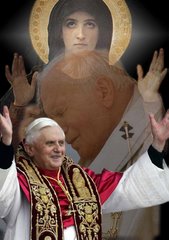
Courtesy of Mark Shea's blog, this is a pretty funny piece to start off your weekend.
Exciting New Tomb Discovery In Mississippi.
Friday, March 02, 2007

LSU Parousians Engage the Consuming Fire Fellowship and Planned Parenthood
"So much death. What can men do against such reckless hate?"
"Ride out with me. Ride out and meet them."-Theoden and Aragorn, Lord of the Rings: The Two Towers
This week was about taking the faith that has been enriched and strengthened by that peculiar bond of fellowship we call the Parousians into the campus. Specifically, into places we knew would be hostile to that faith, places in which we would certainly be challenged. However in both instances I can say that the Parousians came out with a stronger faith and the belief that we made things better by being there and representing the truth.
The first instance came on Tuesday. Every two weeks on Tuesday a group from the Consuming Fire Fellowship comes into LSU’s “Free Speech Alley” and preaches their beliefs. Most of their discussions are about sexuality and sin and salvation (and generally how we have too much of the first two and none of the last). This of course perturbs a great number of the student body who are atheists and what have you. So generally when the Consuming Fire Fellowship comes to campus, we can expect a lot of yelling back and forth and probably a lot of hate as well. Perhaps this would be fine and irrelevant to the Parousians, except that one of the signs they wear has a list of the people going to hell. Next to abortionists, Jehovah Witnesses, and sodomites are, you guessed it, Catholics. I thought that this would be the perfect place to put the love and mercy of the Blessed Mother, so I invited people to come pray the rosary in “Free Speech Alley.” Because it’s the beginning of LSU midterms and during class time, we could only get one other person besides me to go to the rosary, Parousian and Guard member Liz Johnson. That’s alright; I announced it kinda late, and I’m positive it will build. Since we had small numbers, we decided to pray the rosary off to the side.
So we began the rosary. At first the only attention we got from the preachers was from their children. Every time I looked up I could see two little girls casting glances at us. According to Scott Hahn’s wife, Kimberly, the Virgin Mary is almost despised in Protestant circles and I imagine a similar situation if not worse occurs in the households of these young girls. Perhaps I am being fanciful when I say that I think something about the rosary clicked with them. Fulton Sheen argues that Mary is the woman that all girls want to be like, and I think that for those girls that flash of the perfect femininity was attractive or at least interesting and compelling.
It seemed that that would be all the response we would get going into the fifth decade. About halfway through the fifth, the guy with the sign saying that Catholics are going to hell came over and stood next to us. This is probably a child too but not too much younger than I am so that 16 or 17 would be about his age. And he began to tell us, “You know that’s not doing any good. She can’t hear you.” We prayed on. We said the St. Michael’s prayer as he was telling us, very respectfully I should note, that it was a waste of time. So we finished the rosary and immediately began to discuss with him the faith. Liz and I were later joined by another Parousian, Nicole Augustin. And we talked to him about our beliefs, particularly in regard to Mary, purgatory, and the Eucharist, each of us backing the other up when we needed it (Each of the girls did a fantastic job, by the way, which is required when paired with my attempts at apologetics). And he didn’t really know what to say. It was obvious that what we were saying, Michael (that was the young man’s name) had never heard. It clicked with him, and he didn’t know how to handle it. Eventually he got another preacher over and we debated with him awhile until the main preacher Britt Williams, who was also the young man’s father, arrived. Liz and Nicole had to leave for class, leaving me with Rev. Williams and what turned out to be a sort of circle of other people from the Consuming Fire Fellowship. They would come in and out and listen and then walk off, obviously interested in the debate. We talked about requirements for salvation and Church history and abuses. At the end he wasn’t convinced and I had to leave, though I intend to return in two weeks.
The second instance came tonight. A group calling itself “Spiritual Youth for Reproductive Freedom,” with the help of the LSU Women’s Center and a group called Vox: Voices for Planned Parenthood (I’m not quite sure why they use the singular “vox” for the plural “voices,” but that’s another issue) put on a series called “Spirituality and Choice.” This has been a three part series with a session on stem cells, one on sexual education, and the grand finale tonight on Abortion titled, "Can You Choose Choice? Religion and the Pro-Choice Movement". I missed the first one but attended the second one and knew that this was important. The perverse union between spirituality and their ideology is a dangerous one, one that can hurt many young people, especially women. So I wanted a big turnout at their event in order to challenge them. I set up a facebook event, told people about it for a week (and other people talked about it too; lemme be quite clear that any success is not solely my success). Being exam week and being a Planned Parenthood event, I was hoping we could get a few people to give a different perspective.
This was my mindset when I entered the room tonight a little early. I watched as people began to stream in and kept a tally of which ones I knew and which ones I didn’t (we had decided ahead of time to sit separately, so I didn’t have anyone to talk to). The count was a total of 40 people. 13 of them were Parousians. From the question session after that, I think there 5 more pro-lifers in the crowd at least, so that the pro-life group represented a little less than half the crowd. That is incredible. I was so glad to see that people could make it. This happened despite it being a hectic week, despite many people leaving to set up the Veritas retreat this weekend, and despite people’s natural hesitation to go to an event hosted by a pro-choice crowd. I feel we were very blessed.
The Planned Parenthood people probably didn’t feel the same way. They made sure the question and answer session was very short but starting late and letting the presenters read on and on from little stat sheets which were not even really abortion as much as they were about poverty. Yet when the question and answer session came, they were stumped. They couldn’t answer the very basic question a girl we didn’t know asked: when does the fetus become a human? The basic tenet of the pro-life movement and they couldn’t respond. Questions about whether or not a bad abortion was possible and whether or not abortion was simply sweeping under the rug the social issues they had so exhaustively discussed were similarly baffling to them. While no one agreed with us at the end, I think that we show at the very least that the pro-life position is one to be reckoned with and an idea that has significant intellectual merit, which was precisely the opposite goal of their forum.
However, the question can come up: what good did it do? On the surface, we had no conversions. No new Catholics, no new pro-lifers. Perhaps we touched some of them but how much will that matter when they go back to church on Sunday or go back to the Women’s Center and talk about the conference? Did we do any good or did we simply stroke our own egos by trying to beat our opponents in face to face debate? I have to admit, it’s possible that the seeds we tried to sow fell on bad soil. Even if they did however, we did something. I would say that at least for me I came away stronger in my faith, having seen it come up against its enemies and come out intact. But even more than that, I think that the seeds we planted will have an effect. God only needs a crack to flow completely through, and I think we showed these people the cracks in their armor. We made these people think twice about their positions. That’s allowing for God and the Holy Spirit to work. We’ll never know how much of a difference we made this week, but we made a difference.
I want to end this with a quote from the movie Mr. Smith Goes to Washington. In the movie, Senator Smith is forced to defend himself in the Senate and every other senator thinks him a fraud and a troublemaker and wants to expel him from the Senate, so in one of the great scenes of cinematic history Senator Smith filibusters. This is the conclusion to that filibuster (but not the movie, so don’t worry, I didn’t spoil anything for you).
“I guess this is just a lost cause, Mr. Paine. You people don't know about lost causes; Mr. Paine does...You know that you fight for the lost causes harder than for any others. Yes, you even die for them…I'm going to stay right here and fight for this lost cause even if this room gets filled with lies like these until the Taylors and all their armies come marching into this place. Somebody'll listen to me.”
It’s that last sentence which embodies all our hope. Somebody will listen to us if we only keep speaking in witness to Christ.
"Ride out with me. Ride out and meet them."-Theoden and Aragorn, Lord of the Rings: The Two Towers
This week was about taking the faith that has been enriched and strengthened by that peculiar bond of fellowship we call the Parousians into the campus. Specifically, into places we knew would be hostile to that faith, places in which we would certainly be challenged. However in both instances I can say that the Parousians came out with a stronger faith and the belief that we made things better by being there and representing the truth.
The first instance came on Tuesday. Every two weeks on Tuesday a group from the Consuming Fire Fellowship comes into LSU’s “Free Speech Alley” and preaches their beliefs. Most of their discussions are about sexuality and sin and salvation (and generally how we have too much of the first two and none of the last). This of course perturbs a great number of the student body who are atheists and what have you. So generally when the Consuming Fire Fellowship comes to campus, we can expect a lot of yelling back and forth and probably a lot of hate as well. Perhaps this would be fine and irrelevant to the Parousians, except that one of the signs they wear has a list of the people going to hell. Next to abortionists, Jehovah Witnesses, and sodomites are, you guessed it, Catholics. I thought that this would be the perfect place to put the love and mercy of the Blessed Mother, so I invited people to come pray the rosary in “Free Speech Alley.” Because it’s the beginning of LSU midterms and during class time, we could only get one other person besides me to go to the rosary, Parousian and Guard member Liz Johnson. That’s alright; I announced it kinda late, and I’m positive it will build. Since we had small numbers, we decided to pray the rosary off to the side.
So we began the rosary. At first the only attention we got from the preachers was from their children. Every time I looked up I could see two little girls casting glances at us. According to Scott Hahn’s wife, Kimberly, the Virgin Mary is almost despised in Protestant circles and I imagine a similar situation if not worse occurs in the households of these young girls. Perhaps I am being fanciful when I say that I think something about the rosary clicked with them. Fulton Sheen argues that Mary is the woman that all girls want to be like, and I think that for those girls that flash of the perfect femininity was attractive or at least interesting and compelling.
It seemed that that would be all the response we would get going into the fifth decade. About halfway through the fifth, the guy with the sign saying that Catholics are going to hell came over and stood next to us. This is probably a child too but not too much younger than I am so that 16 or 17 would be about his age. And he began to tell us, “You know that’s not doing any good. She can’t hear you.” We prayed on. We said the St. Michael’s prayer as he was telling us, very respectfully I should note, that it was a waste of time. So we finished the rosary and immediately began to discuss with him the faith. Liz and I were later joined by another Parousian, Nicole Augustin. And we talked to him about our beliefs, particularly in regard to Mary, purgatory, and the Eucharist, each of us backing the other up when we needed it (Each of the girls did a fantastic job, by the way, which is required when paired with my attempts at apologetics). And he didn’t really know what to say. It was obvious that what we were saying, Michael (that was the young man’s name) had never heard. It clicked with him, and he didn’t know how to handle it. Eventually he got another preacher over and we debated with him awhile until the main preacher Britt Williams, who was also the young man’s father, arrived. Liz and Nicole had to leave for class, leaving me with Rev. Williams and what turned out to be a sort of circle of other people from the Consuming Fire Fellowship. They would come in and out and listen and then walk off, obviously interested in the debate. We talked about requirements for salvation and Church history and abuses. At the end he wasn’t convinced and I had to leave, though I intend to return in two weeks.
The second instance came tonight. A group calling itself “Spiritual Youth for Reproductive Freedom,” with the help of the LSU Women’s Center and a group called Vox: Voices for Planned Parenthood (I’m not quite sure why they use the singular “vox” for the plural “voices,” but that’s another issue) put on a series called “Spirituality and Choice.” This has been a three part series with a session on stem cells, one on sexual education, and the grand finale tonight on Abortion titled, "Can You Choose Choice? Religion and the Pro-Choice Movement". I missed the first one but attended the second one and knew that this was important. The perverse union between spirituality and their ideology is a dangerous one, one that can hurt many young people, especially women. So I wanted a big turnout at their event in order to challenge them. I set up a facebook event, told people about it for a week (and other people talked about it too; lemme be quite clear that any success is not solely my success). Being exam week and being a Planned Parenthood event, I was hoping we could get a few people to give a different perspective.
This was my mindset when I entered the room tonight a little early. I watched as people began to stream in and kept a tally of which ones I knew and which ones I didn’t (we had decided ahead of time to sit separately, so I didn’t have anyone to talk to). The count was a total of 40 people. 13 of them were Parousians. From the question session after that, I think there 5 more pro-lifers in the crowd at least, so that the pro-life group represented a little less than half the crowd. That is incredible. I was so glad to see that people could make it. This happened despite it being a hectic week, despite many people leaving to set up the Veritas retreat this weekend, and despite people’s natural hesitation to go to an event hosted by a pro-choice crowd. I feel we were very blessed.
The Planned Parenthood people probably didn’t feel the same way. They made sure the question and answer session was very short but starting late and letting the presenters read on and on from little stat sheets which were not even really abortion as much as they were about poverty. Yet when the question and answer session came, they were stumped. They couldn’t answer the very basic question a girl we didn’t know asked: when does the fetus become a human? The basic tenet of the pro-life movement and they couldn’t respond. Questions about whether or not a bad abortion was possible and whether or not abortion was simply sweeping under the rug the social issues they had so exhaustively discussed were similarly baffling to them. While no one agreed with us at the end, I think that we show at the very least that the pro-life position is one to be reckoned with and an idea that has significant intellectual merit, which was precisely the opposite goal of their forum.
However, the question can come up: what good did it do? On the surface, we had no conversions. No new Catholics, no new pro-lifers. Perhaps we touched some of them but how much will that matter when they go back to church on Sunday or go back to the Women’s Center and talk about the conference? Did we do any good or did we simply stroke our own egos by trying to beat our opponents in face to face debate? I have to admit, it’s possible that the seeds we tried to sow fell on bad soil. Even if they did however, we did something. I would say that at least for me I came away stronger in my faith, having seen it come up against its enemies and come out intact. But even more than that, I think that the seeds we planted will have an effect. God only needs a crack to flow completely through, and I think we showed these people the cracks in their armor. We made these people think twice about their positions. That’s allowing for God and the Holy Spirit to work. We’ll never know how much of a difference we made this week, but we made a difference.
I want to end this with a quote from the movie Mr. Smith Goes to Washington. In the movie, Senator Smith is forced to defend himself in the Senate and every other senator thinks him a fraud and a troublemaker and wants to expel him from the Senate, so in one of the great scenes of cinematic history Senator Smith filibusters. This is the conclusion to that filibuster (but not the movie, so don’t worry, I didn’t spoil anything for you).
“I guess this is just a lost cause, Mr. Paine. You people don't know about lost causes; Mr. Paine does...You know that you fight for the lost causes harder than for any others. Yes, you even die for them…I'm going to stay right here and fight for this lost cause even if this room gets filled with lies like these until the Taylors and all their armies come marching into this place. Somebody'll listen to me.”
It’s that last sentence which embodies all our hope. Somebody will listen to us if we only keep speaking in witness to Christ.
Wednesday, February 28, 2007
Tridentine Mass

I've attended a few Tridentine Masses and each time I've come away disappointed. Part of the reason for this could be that the masses I attended were in South Florida, where most of the Latin Mass church-goers look and act like Uncle Lewis and Aunt Bethany from National Lampoon's Christmas Vacation. But the bigger problem is that I came away each time feeling as though I hadn't been to mass at all. Perhaps I expected too much, but instead of experiencing awe and reverence I just felt frustration and disillusionment. I kind of assumed that it was a personal defect, perhaps the consequence of not having adequately prepared myself. So I was heartened to read this post by Dan at Holy Whapping, which perfectly captures the uneasiness I've experienced before in the Tridentine Mass:
when you show up at the local indult parish, you discover something very different from what you expected.There's an extended discussion in the comboxes at Holy Whapping.
- Participation is discouraged, except perhaps on a few chants
- It is very hard to keep track of anything for those who haven't already gotten it down
- The whole experience has a vaguely dusty feel
- Many pamphlets and literature around the Church, with the exception of maybe some natural family planning materials, feel frozen in time somewhere around the 1920's.
What I am arguing, then, is that the Tridentine Mass, as currently celebrated in indult parishes, at least those I have seen, is celebrated in such a way as to necessarily become an "acquired taste." Furthermore, an approach is often taken to make it seem as if the indult is carte blanche to act as if nothing in the Church has changed since the early 1940's, and to make such completely orthodox movements as the nouvelle theologie or even Vatican II itself as a council, seem suspect. This is not a good approach, and it works very much against integrating traditional liturgy into the present day life of the Church. This approach is not one that, in my experience, easily appeals to young people looking for beauty and transcendence, unless they're already convinced to keep coming for other reasons, or have someone to explain everything to them in detail and keep them coming back.
...
In other words, why can't we have "tradition" without "ism" in these quarters, and be willing to have the Tridentine Mass and Vatican II and new developments in theology?
Tuesday, February 27, 2007
Maybe the Parousians Can Go Home Now
A new documentary claims that the remains of Jesus, his wife Mary Magdalene, and their son have been found. Titanic director James Cameron is the executive producer. I still haven't seen that one either.
I watched a little bit of CNN's coverage of this last night. It seems that the mainstream media is finding little credibility in the story, but will the consumer culture reject it?
But now, since we have the DNA samples, perhaps we can finally clone Jesus.
I watched a little bit of CNN's coverage of this last night. It seems that the mainstream media is finding little credibility in the story, but will the consumer culture reject it?
But now, since we have the DNA samples, perhaps we can finally clone Jesus.
Monday, February 26, 2007
Happy Birthday
This is courtesy of Paul Cat. I think this video addresses something not talked about too often and that is the father's feelings following an abortion. The idea of reflecting on what the child would be has been brought up in connection with the mother but we often forget that the father will have the same naggings of conscience.
Happy Birthday, I Love You Whoever You Would Have Been.
Happy Birthday, I Love You Whoever You Would Have Been.
Sunday, February 25, 2007
New Hope for Catholic Literature
The article Pop Excess cites Catholic Writers Groups Foster Literary Revival (both from the National Catholic Register) as part of a hopeful change in pop culture beginning with literature, "There’s another reason the arts have become a cesspool: Call it a sin of omission by Catholics.
For decades, the Church in America has been marked by dissent. Catholic filmmakers, novelists and artists have been here all along — but their products have become morally indistinguishable from the culture’s.
But that’s starting to change. There are two examples in this issue: Tim Drake’s story about the new literary revival (page 2) and our profile of Jordan Allott on our Arts & Entertainment page (B3)."
Tim Drake's article notes one group in particular, "The Minnklings," who are "a Minnesotan take-off on C.S. Lewis’ and J.R.R. Tolkien’s writer’s group The Inklings. Among others, it includes a newspaper publisher, an academic journal editor, published fiction writers and journalists. They gather to critique one another’s work and share stories about getting published. The group is one of several literary efforts underway aimed at supporting existing Catholic writers and fostering new ones."
Some very exciting stuff going on here.
Freedom of...Prejudice?
A quote by Greg Kandra from the National Catholic Register's article, The Bias Against Belief, “The episode has drawn attention to an issue that strikes close to my own life,” wrote Kandra. “It involves a particularly insidious form of bigotry, and the nagging suspicion that there is one remaining permissible prejudice in America. It is anti-Catholicism.”
Praying for Atheists
Mark Shea offers us insight into opening our hearts towards atheists in this article appearing in the National Catholic Register, Praying for Atheists.
Mark Shea writes in reference to atheism and atheists, "The truth, of course, is that there is always a difference between an idea and the person who holds it." This is perhaps something we should all keep in mind especially when working with our brothers and sisters who will not intellectually recognize God, but who so often recognize Him through their loving actions helping those less-fortunate than themselves.
Mark Shea writes in reference to atheism and atheists, "The truth, of course, is that there is always a difference between an idea and the person who holds it." This is perhaps something we should all keep in mind especially when working with our brothers and sisters who will not intellectually recognize God, but who so often recognize Him through their loving actions helping those less-fortunate than themselves.
#7 Screwtape Letter: Existence of Demons and Factionalism
This letter, more than any we’ve seen so far, really breaks itself down into two separate letters. The first half is devoted to the question of whether or not Wormwood should put special effort into keeping the patient ignorant of his existence. Screwtape answers that the question has been answered by the High Command to keep ignorant but he explains that both ignorance and belief have their drawbacks:
“When the humans disbelieve in our existence we lose all the pleasing results of direct terrorism and we make no magicians. On the other hand, when they believe in us, we cannot make them materialists and skeptics.”
That is, the existence of demons and Satan points us to a spiritual world in which materialism does not make sense. Without belief in this existence, it is easier for Wormwood to direct the patient towards world in which there is only matter, a world in which things like Truth and Morality start to lose meaning. On the other hand, belief in spiritual world is not enough for conversion but only heightens the stakes. Sure, belief in God can come but it can also be used for a more potent evil. Think of Star Wars for a minute (hey, you didn’t honestly think I was going to write about 31 letters and not refer to Star Wars once, did you?). Darth Vader and Emperor Palpatine both believed in the Force very strongly, but that belief did not translate into goodness. Instead, they manipulated this secret force for their own ends and became much more powerful than a legion of storm troopers. A similar thing can happen for those who see spirituality but misinterpret it or pervert it. Planned Parenthood is doing this right now at LSU with their Spirituality and Sexuality Series in which they claim that it is acceptable and perhaps even mandatory to be both spiritual and pro-abortion, pro-contraception, and pro-sexual liberation. So while we have to recognize that getting people to recognize the spiritual world is a crucial step towards lifting people out of the indifferent and hollow world of the materialists, it’s not the end of the journey. (Speaking of those Planned Parenthood people, 7:00 PM in the Atchafalaya Room in the Union on Thursday is the finale of their series. Please attend if you can. Now back to our regularly scheduled programming)
Screwtape mentions one more thing that is helpful for us to recognize. He tells Wormwood:
“The fact that ‘devils’ are predominantly comic figures in the modern imagination will help you. If any faint suspicion of your existence beings to arise in his mind, suggest to him a picture of something in red tights, and persuade him that since he cannot believe in that…he therefore cannot believe in you.”
We need to be careful in how we describe the forces of evil both to others and to ourselves, lest we make them too anthropomorphic as to be ridiculous. Satan and his servants existence, but images of pitchforks and horns help Screwtape more than they help us.
Now we get to the second half of the letter in which Screwtape address the issue of whether or not Wormwood should try to make his patient an extreme patriot or extreme pacifist. Surprisingly to us who live in a world in which support or dissent of the Iraq War seems to be the prime litmus test, Screwtape says it doesn’t really matter. As he says,
“All extremes, except extreme devotion to the Enemy, are to be encouraged…Some ages are lukewarm and complacent, and then it is our business to soothe them yet faster asleep. Other ages, of which the present is one, are unbalanced and prone to faction, and it is our business to inflame them. Any small coterie…tends to develop inside itself a hothouse mutual admiration, and towards the outer world, a great deal of pride and hatred which is entertained without shame because the ‘Cause’ is its sponsor and it is thought to be impersonal. Even when the little group exists originally for the Enemy’s own purposes, this remains true. We want the Church to be small not only that fewer men may know the Enemy but also that those who do may acquire the uneasy intensity and defensive self-righteous of a secret society of a clique”
That’s a pretty long quote so there’s a lot to unpack from it. The first is an obvious preference for moderation in beliefs. Note however that this does not mean indifference or a rejection of both patriotism and pacifism. Instead, it’s recognition that extreme beliefs can become consuming and as such take us away from Christ. Second, it shows a danger to anger that we as Catholics in the university and more importantly as Catholics in the world face. We are a small group and therefore have a real disposition to the “us/them” mentality. This is particularly challenging for us as Parousians and as the laity under the New Evangelization of John Paul II. We are called to engage a university which is hostile to us and we probably will need to rely strongly on others and on our Catholic community as well as Christ’s grace to make it through it, yet we cannot become so entrenched in our community as to become disdainful of anything outside of it. This primarily means loving those who would appear to be our enemies, including those at Planned Parenthood (and I’m writing this as much to me as I am to you. Told you Lewis had a knack to skewer everybody, even bloggers). Third, we have to watch out for factionalism in our communities. “Divide and conquer” is the old saying and it can wreak havoc. Not even the Church is immune; see those who hold hands at the Our Father and those who don’t as a good indicator that our Church is not as united as it should be. When we disagree then, one of our goals in disagreeing should be a greater unity then before instead of simply another faction.
You may have wondered how what seemed to be a discussion on war and pacifism versus patriotism turned into a discussion of factions. Lewis generally isn’t concerned with the correct stance on war as he is about our attitudes to it and how war as an especially trying emotional and spiritual experience can lead us closer to either Hell or Heaven. He is especially concerned with concern about the war becoming the central point of our existence and especially of our faith. Screwtape writes,
“Let him begin by treating the Patriotism or the Pacifism as part of his religion. Then let him, under the influence of partisan spirit, come to regard it as the most important part. Then quietly and gradually nurse him on to the stage at which the religion becomes merely part of the ‘cause,’ in which Christianity is valued chiefly because of the excellent arguments in can produce in favour of the British war-effort or of Pacifism…Once you have made the World an end, and faith a means, you have almost won your man, and it makes very little difference what kind of worldly end he is pursuing. Provided that meetings, pamphlets, policies, movements, causes, and crusades matter more to him than prayers and sacraments and charity-he is ours.”
That’s fairly harsh, and as a group devoted to many causes we need to pay close attention to what Lewis is trying to tell us here. He’s not telling us to back away from causes,-he wouldn’t have been so involved in popular apologetics if he didn’t think that the world needed to be told to wake itself up-he’s telling us that that shouldn’t be the focus. Instead, religion should be the focus and the causes derived from it. We seek pro-life changes because God has told us that we should respect the dignity of human life; we should not seek God b/c we’ve decided to be pro-life and need back-up. The same applies to all issues, not just issues of war. We follow causes because in them we follow God; we shouldn’t follow God because He takes us farther in our quest for the cause.
I want to close with a quote from Richard Nixon. Odd source for inspirtational quotes, I know, and I’m not a big fan of the man myself. However, this quote was a favorite of my father’s and so I’ve come to like it too.
“Always remember others may hate you but those who hate you don't win unless you hate them. And then you destroy yourself.”
N.B. I realized about mid-way through this that there are some who might not like the dichotomy between Patriotism and Pacifism, as many today are easily angered by the association of opposition to the war with being unpatriotic. First, those are Lewis’s word’s, not mine. Second, I don’t think Lewis was trying to imply that; he’s certainly not one to join in the chorus of those today who claim opposition to the war in Iraq is necessarily unpatriotic. Remember, Lewis was friends with J.R.R. Tolkien, who was a pacifist in some respects (though he saw the war with Germany as a necessary evil as he wrote to his son, who fought in the war). Both Tolkien and Lewis served in WWI and had problems resulting from it so I highly doubt that Lewis demands support for war in order to be patriotic. It should also be noted that the patient never fights in the war and Lewis does not argue that it is a victory of Screwtape that he stayed home.
“When the humans disbelieve in our existence we lose all the pleasing results of direct terrorism and we make no magicians. On the other hand, when they believe in us, we cannot make them materialists and skeptics.”
That is, the existence of demons and Satan points us to a spiritual world in which materialism does not make sense. Without belief in this existence, it is easier for Wormwood to direct the patient towards world in which there is only matter, a world in which things like Truth and Morality start to lose meaning. On the other hand, belief in spiritual world is not enough for conversion but only heightens the stakes. Sure, belief in God can come but it can also be used for a more potent evil. Think of Star Wars for a minute (hey, you didn’t honestly think I was going to write about 31 letters and not refer to Star Wars once, did you?). Darth Vader and Emperor Palpatine both believed in the Force very strongly, but that belief did not translate into goodness. Instead, they manipulated this secret force for their own ends and became much more powerful than a legion of storm troopers. A similar thing can happen for those who see spirituality but misinterpret it or pervert it. Planned Parenthood is doing this right now at LSU with their Spirituality and Sexuality Series in which they claim that it is acceptable and perhaps even mandatory to be both spiritual and pro-abortion, pro-contraception, and pro-sexual liberation. So while we have to recognize that getting people to recognize the spiritual world is a crucial step towards lifting people out of the indifferent and hollow world of the materialists, it’s not the end of the journey. (Speaking of those Planned Parenthood people, 7:00 PM in the Atchafalaya Room in the Union on Thursday is the finale of their series. Please attend if you can. Now back to our regularly scheduled programming)
Screwtape mentions one more thing that is helpful for us to recognize. He tells Wormwood:
“The fact that ‘devils’ are predominantly comic figures in the modern imagination will help you. If any faint suspicion of your existence beings to arise in his mind, suggest to him a picture of something in red tights, and persuade him that since he cannot believe in that…he therefore cannot believe in you.”
We need to be careful in how we describe the forces of evil both to others and to ourselves, lest we make them too anthropomorphic as to be ridiculous. Satan and his servants existence, but images of pitchforks and horns help Screwtape more than they help us.
Now we get to the second half of the letter in which Screwtape address the issue of whether or not Wormwood should try to make his patient an extreme patriot or extreme pacifist. Surprisingly to us who live in a world in which support or dissent of the Iraq War seems to be the prime litmus test, Screwtape says it doesn’t really matter. As he says,
“All extremes, except extreme devotion to the Enemy, are to be encouraged…Some ages are lukewarm and complacent, and then it is our business to soothe them yet faster asleep. Other ages, of which the present is one, are unbalanced and prone to faction, and it is our business to inflame them. Any small coterie…tends to develop inside itself a hothouse mutual admiration, and towards the outer world, a great deal of pride and hatred which is entertained without shame because the ‘Cause’ is its sponsor and it is thought to be impersonal. Even when the little group exists originally for the Enemy’s own purposes, this remains true. We want the Church to be small not only that fewer men may know the Enemy but also that those who do may acquire the uneasy intensity and defensive self-righteous of a secret society of a clique”
That’s a pretty long quote so there’s a lot to unpack from it. The first is an obvious preference for moderation in beliefs. Note however that this does not mean indifference or a rejection of both patriotism and pacifism. Instead, it’s recognition that extreme beliefs can become consuming and as such take us away from Christ. Second, it shows a danger to anger that we as Catholics in the university and more importantly as Catholics in the world face. We are a small group and therefore have a real disposition to the “us/them” mentality. This is particularly challenging for us as Parousians and as the laity under the New Evangelization of John Paul II. We are called to engage a university which is hostile to us and we probably will need to rely strongly on others and on our Catholic community as well as Christ’s grace to make it through it, yet we cannot become so entrenched in our community as to become disdainful of anything outside of it. This primarily means loving those who would appear to be our enemies, including those at Planned Parenthood (and I’m writing this as much to me as I am to you. Told you Lewis had a knack to skewer everybody, even bloggers). Third, we have to watch out for factionalism in our communities. “Divide and conquer” is the old saying and it can wreak havoc. Not even the Church is immune; see those who hold hands at the Our Father and those who don’t as a good indicator that our Church is not as united as it should be. When we disagree then, one of our goals in disagreeing should be a greater unity then before instead of simply another faction.
You may have wondered how what seemed to be a discussion on war and pacifism versus patriotism turned into a discussion of factions. Lewis generally isn’t concerned with the correct stance on war as he is about our attitudes to it and how war as an especially trying emotional and spiritual experience can lead us closer to either Hell or Heaven. He is especially concerned with concern about the war becoming the central point of our existence and especially of our faith. Screwtape writes,
“Let him begin by treating the Patriotism or the Pacifism as part of his religion. Then let him, under the influence of partisan spirit, come to regard it as the most important part. Then quietly and gradually nurse him on to the stage at which the religion becomes merely part of the ‘cause,’ in which Christianity is valued chiefly because of the excellent arguments in can produce in favour of the British war-effort or of Pacifism…Once you have made the World an end, and faith a means, you have almost won your man, and it makes very little difference what kind of worldly end he is pursuing. Provided that meetings, pamphlets, policies, movements, causes, and crusades matter more to him than prayers and sacraments and charity-he is ours.”
That’s fairly harsh, and as a group devoted to many causes we need to pay close attention to what Lewis is trying to tell us here. He’s not telling us to back away from causes,-he wouldn’t have been so involved in popular apologetics if he didn’t think that the world needed to be told to wake itself up-he’s telling us that that shouldn’t be the focus. Instead, religion should be the focus and the causes derived from it. We seek pro-life changes because God has told us that we should respect the dignity of human life; we should not seek God b/c we’ve decided to be pro-life and need back-up. The same applies to all issues, not just issues of war. We follow causes because in them we follow God; we shouldn’t follow God because He takes us farther in our quest for the cause.
I want to close with a quote from Richard Nixon. Odd source for inspirtational quotes, I know, and I’m not a big fan of the man myself. However, this quote was a favorite of my father’s and so I’ve come to like it too.
“Always remember others may hate you but those who hate you don't win unless you hate them. And then you destroy yourself.”
N.B. I realized about mid-way through this that there are some who might not like the dichotomy between Patriotism and Pacifism, as many today are easily angered by the association of opposition to the war with being unpatriotic. First, those are Lewis’s word’s, not mine. Second, I don’t think Lewis was trying to imply that; he’s certainly not one to join in the chorus of those today who claim opposition to the war in Iraq is necessarily unpatriotic. Remember, Lewis was friends with J.R.R. Tolkien, who was a pacifist in some respects (though he saw the war with Germany as a necessary evil as he wrote to his son, who fought in the war). Both Tolkien and Lewis served in WWI and had problems resulting from it so I highly doubt that Lewis demands support for war in order to be patriotic. It should also be noted that the patient never fights in the war and Lewis does not argue that it is a victory of Screwtape that he stayed home.
Saturday, February 24, 2007
Prenatal genetic screenings
Unfit to live? Children with Down's syndrome in Canadian crosshairs
A Canadian medical group is advocating prenatal genetic screening for all pregnant women. Specifically, Down's syndrome testing seems to be the main focus. What does this mean for a woman pregnant with a child who has Down's syndrome? Will the testing make her better prepared to take care of this child? Or will the test give her a reason to abort her child? Is this a step towards better care of Down's syndrome children or just towards eugenics and the death of these children? Who gets to decide?#6 Screwtape Letter: Preoccupation with the Future and Man as a Series of Circles
Now that the patient has begun to pray, Screwtape instructs Wormwood on more techniques to help misdirect his prayers and thoughts. The first method is looking to the future at the expense of the present. Screwtape writes:
It is your business to see that the patient never thinks of the present fear as his appointed cross, but only of the things he is afraid of. Let him regard them as his crosses: let him forget that, since they are incompatible, they cannot all happen to him, and let him try to practice fortitude and patience to them all in advance. For real resignation, at the same moment, to a dozen different and hypothetical fates, is almost impossible.
I think this approach is especially beneficial to Screwtape for a few reasons. The first is, as Screwtape saws, true resignation to a dozen fates is impossible. This means that by attempting to resign ourselves to everything, we actually prevent the resignation and full trust in God that we are seeking. Again, we shoot too high and miss. The second is that by concentrating on the future too much we forget to seek comfort on the present crosses that God is fully prepared to help us deal with. The Eucharist is our daily bread and as such the grace is best when applied to the daily i.e. present problems. Finally, I think that dealing too much with potential crosses likely inflates our ego. If we think that we’re dealing with twenty crosses when we likely only have two, we probably think that God is dealing us a harder card then we have. This can lead to an inflates sense of what God “owes” us as well as tendency to “holier than thou” as we believe that we alone are dealing with so much and persevering whereas others have much less to deal with.
The next paragraph deals with more of Screwtape’s directions on how to distract the patient from the real issue. You’ll have noticed by now that a major theme of the Screwtape Letters is distracting the patient from the truth of things into an imaginary comfort zone in which it is harder for God to work.
One can then formulate the general rule; in all activities of mind which favour our cause, encourage the patient to be unself-conscious and to concentrate on the object, but in all activities favourable to the Enemy bend his mind back on itself.
What this means is this: when we deal in sin, we need to look at ourselves. Give ourselves the hard look or the examination of conscience and see what we’ve done wrong so that we can ask for the grace to change it. On the other hand, when we are presented with good or do good or focus should be on God. When we view the sunset as the sun slowly sinks into the mountains bathing the area in an orange glow or when we see pictures of Mother Teresa, our focus should not be on how that makes us feel but on the cause of these scenes which is God. To take an argument from Aristotle, if the highest thing is contemplate the divine than we should be careful not to substitute that for contemplating us thinking about the divine. The difference might seem small but it opens a large hole for the Screwtapes.
The last thing to draw from this letter is the idea of man as concentric circles. I found this particularly interesting as I had read something similar in a book called Lift Up Your Heart written by Lewis’s Catholic equivalent (or superior, depending on your point of view), Bishop Fulton J. Sheen. I’ll put the two quotes side by side so you can compare:
Lewis:
“Think of your man as a series of concentric circles, his will being the innermost, his intellect coming next, and finally his fantasy. You can hardly hope, at once, to exclude from all the circles everything that smells of the Enemy: but you must keep shoving all the virtues outward till they are finally located in the circle of fantasy.”
Sheen:
“Our happiness varies according to the center about which our lives revolve. If it is the ego, there are frustrations; if it is the I, there is a measure of natural happiness, still incomplete. If it is the divine, there is the joy of being one with the Infinite Life and Truth and Love.”
I think there the idea of man as a circle is very crucial; it shows that there has to be one thing around which we revolve, only one thing which we make the center of our life. However, what that center is (or should be) is very different for the Anglican Lewis and the Catholic Sheen. Lewis thinks it ought to be the will. In today’s world of psychology and other attempts to disenfranchise man of his free will and ability to choose, this can be a helpful construct. And as Lewis writes on later in the letter, it is in the will which our choices must be concentrated in order to reflect real virtue. However, the will is still an aspect of man. Believe or not, I’m going to say that Lewis was wrong (there won’t be many times I can say that). God instead should be the center of our lives, with the I (which is very close to the will for Sheen and can reflect and love as opposed to the totally selfish ego) revolving around God, not being the center. Indeed, for Sheen, having the will or the I at the center is better than just the ego but still insufficient. For the Catholic Sheen, anything less than total abandonment of the self to God is unsatisfactory.
Next Letter: Acknowledging the existence of demons and the question of Pacifism.
It is your business to see that the patient never thinks of the present fear as his appointed cross, but only of the things he is afraid of. Let him regard them as his crosses: let him forget that, since they are incompatible, they cannot all happen to him, and let him try to practice fortitude and patience to them all in advance. For real resignation, at the same moment, to a dozen different and hypothetical fates, is almost impossible.
I think this approach is especially beneficial to Screwtape for a few reasons. The first is, as Screwtape saws, true resignation to a dozen fates is impossible. This means that by attempting to resign ourselves to everything, we actually prevent the resignation and full trust in God that we are seeking. Again, we shoot too high and miss. The second is that by concentrating on the future too much we forget to seek comfort on the present crosses that God is fully prepared to help us deal with. The Eucharist is our daily bread and as such the grace is best when applied to the daily i.e. present problems. Finally, I think that dealing too much with potential crosses likely inflates our ego. If we think that we’re dealing with twenty crosses when we likely only have two, we probably think that God is dealing us a harder card then we have. This can lead to an inflates sense of what God “owes” us as well as tendency to “holier than thou” as we believe that we alone are dealing with so much and persevering whereas others have much less to deal with.
The next paragraph deals with more of Screwtape’s directions on how to distract the patient from the real issue. You’ll have noticed by now that a major theme of the Screwtape Letters is distracting the patient from the truth of things into an imaginary comfort zone in which it is harder for God to work.
One can then formulate the general rule; in all activities of mind which favour our cause, encourage the patient to be unself-conscious and to concentrate on the object, but in all activities favourable to the Enemy bend his mind back on itself.
What this means is this: when we deal in sin, we need to look at ourselves. Give ourselves the hard look or the examination of conscience and see what we’ve done wrong so that we can ask for the grace to change it. On the other hand, when we are presented with good or do good or focus should be on God. When we view the sunset as the sun slowly sinks into the mountains bathing the area in an orange glow or when we see pictures of Mother Teresa, our focus should not be on how that makes us feel but on the cause of these scenes which is God. To take an argument from Aristotle, if the highest thing is contemplate the divine than we should be careful not to substitute that for contemplating us thinking about the divine. The difference might seem small but it opens a large hole for the Screwtapes.
The last thing to draw from this letter is the idea of man as concentric circles. I found this particularly interesting as I had read something similar in a book called Lift Up Your Heart written by Lewis’s Catholic equivalent (or superior, depending on your point of view), Bishop Fulton J. Sheen. I’ll put the two quotes side by side so you can compare:
Lewis:
“Think of your man as a series of concentric circles, his will being the innermost, his intellect coming next, and finally his fantasy. You can hardly hope, at once, to exclude from all the circles everything that smells of the Enemy: but you must keep shoving all the virtues outward till they are finally located in the circle of fantasy.”
Sheen:
“Our happiness varies according to the center about which our lives revolve. If it is the ego, there are frustrations; if it is the I, there is a measure of natural happiness, still incomplete. If it is the divine, there is the joy of being one with the Infinite Life and Truth and Love.”
I think there the idea of man as a circle is very crucial; it shows that there has to be one thing around which we revolve, only one thing which we make the center of our life. However, what that center is (or should be) is very different for the Anglican Lewis and the Catholic Sheen. Lewis thinks it ought to be the will. In today’s world of psychology and other attempts to disenfranchise man of his free will and ability to choose, this can be a helpful construct. And as Lewis writes on later in the letter, it is in the will which our choices must be concentrated in order to reflect real virtue. However, the will is still an aspect of man. Believe or not, I’m going to say that Lewis was wrong (there won’t be many times I can say that). God instead should be the center of our lives, with the I (which is very close to the will for Sheen and can reflect and love as opposed to the totally selfish ego) revolving around God, not being the center. Indeed, for Sheen, having the will or the I at the center is better than just the ego but still insufficient. For the Catholic Sheen, anything less than total abandonment of the self to God is unsatisfactory.
Next Letter: Acknowledging the existence of demons and the question of Pacifism.
Friday, February 23, 2007
The Dignity of Choice
This is an excellent post by the "Aggie Catholic" discussing the ramifications of the pro-abortion side's decision to align themselves strongly with the concept of choice.
The Dignity of Choice.
The Dignity of Choice.
Psychologists catch on to what we already know
This is a link from Dawn Eden's post on the importance of female and male virginity.
The WashingtonPost.com reviews a report by the American Psychological Association's Task Force on the Sexualization of Girls in this article titled, Goodbye to Girlhood
As Pop Culture Targets Ever Younger Girls, Psychologists Worry About a Premature Focus on Sex and Appearance.
Does this make anyone else think of JonBenet Ramsey?
The WashingtonPost.com reviews a report by the American Psychological Association's Task Force on the Sexualization of Girls in this article titled, Goodbye to Girlhood
As Pop Culture Targets Ever Younger Girls, Psychologists Worry About a Premature Focus on Sex and Appearance.
Does this make anyone else think of JonBenet Ramsey?
Anti-contraception Letter to the Editor Published
Some guy wrote a letter in to the editor of the Daily Reveille defending Emily's and the Church's position on contraception. It's not very good, but as pro-Church items in the Reveille are rare I decided to post it anyway.
Letter defending Emily's position on contraception.
Letter defending Emily's position on contraception.
Thursday, February 22, 2007
Is Female Virginity More Valuable than Male Virginity
Dawn Eden and Elizabeth Kantor debate the issue.
Before anyone thinks I am playing up the sexual double standard, let me be clear that I'm siding with Dawn Eden on this one, but Kantor makes an interesting case.
Before anyone thinks I am playing up the sexual double standard, let me be clear that I'm siding with Dawn Eden on this one, but Kantor makes an interesting case.
Response to Emily's Abstinence Column
Last week Emily wrote a column denouncing programs that teach contraception. Because the Daily Reveille likes to publish lengthy rebuttals to anything Emily writes, today next to Emily's column we have the misfortune of reading a response piece put out by a women's studies major. If you have the time, please respond to this piece of....work.
Response Piece to Emily's Abstinence Column.
Response Piece to Emily's Abstinence Column.
Emily Byers on Fasting
Emily Byers writes in this week's edition of the Daily Reveille about fasting and how it brings us into closer solidarity with the poor and hungry.
Lenten Sacrifice Strengthens Faith.
Lenten Sacrifice Strengthens Faith.
Subscribe to:
Posts (Atom)